The Simplicity and Preeminence of Christ
The gospel is not complicated. The message is Jesus Christ. Not Jesus plus our politics. Not Jesus plus our denomination. Not Jesus plus our favorite teacher. Not Jesus plus religious entertainment, personal ambition, institutional loyalty, or human wisdom.
The message is: JESUS.
Paul feared that believers could be drawn away from what he called “the simplicity that is in Christ.” He warned the Corinthians about accepting another Jesus, a different spirit, or a different gospel (2 Corinthians 11:3–4). He was equally severe with the Galatians: if anyone preached a gospel different from the one they had received, that message was to be rejected.
Why such strong language?
Because once Jesus is displaced from the center, Christianity may retain its vocabulary while losing its substance. Without Jesus it is not Christian. It is not scriptural.
Paul therefore made an extraordinary declaration concerning his own ministry: “I determined not to know anything among you except Jesus Christ and Him crucified.”
That was not theological ignorance. Paul knew Scripture profoundly. It was theological concentration. Theology must lead to a burning heart that sees Jesus. He understood what mattered most: CHRIST AND HIM CRUCIFIED.
The cross cannot be treated as merely the entrance into Christianity before we graduate into something supposedly deeper. The cross is the center. It is the Christian life. We die daily and are resurrected daily.
Paul said the message of the cross is foolishness to those who are perishing, but to those being saved it is the power of God. While some demanded signs and others sought intellectual sophistication, Paul declared: “We preach Christ crucified.”
And in 1 Corinthians 15, Paul summarized the gospel he had received and delivered: Christ died for our sins according to the Scriptures, He was buried, and He rose again.
There it is: Christ crucified. Christ buried. Christ risen. Christ reigning.
Christianity begins, continues, and ends with Him.
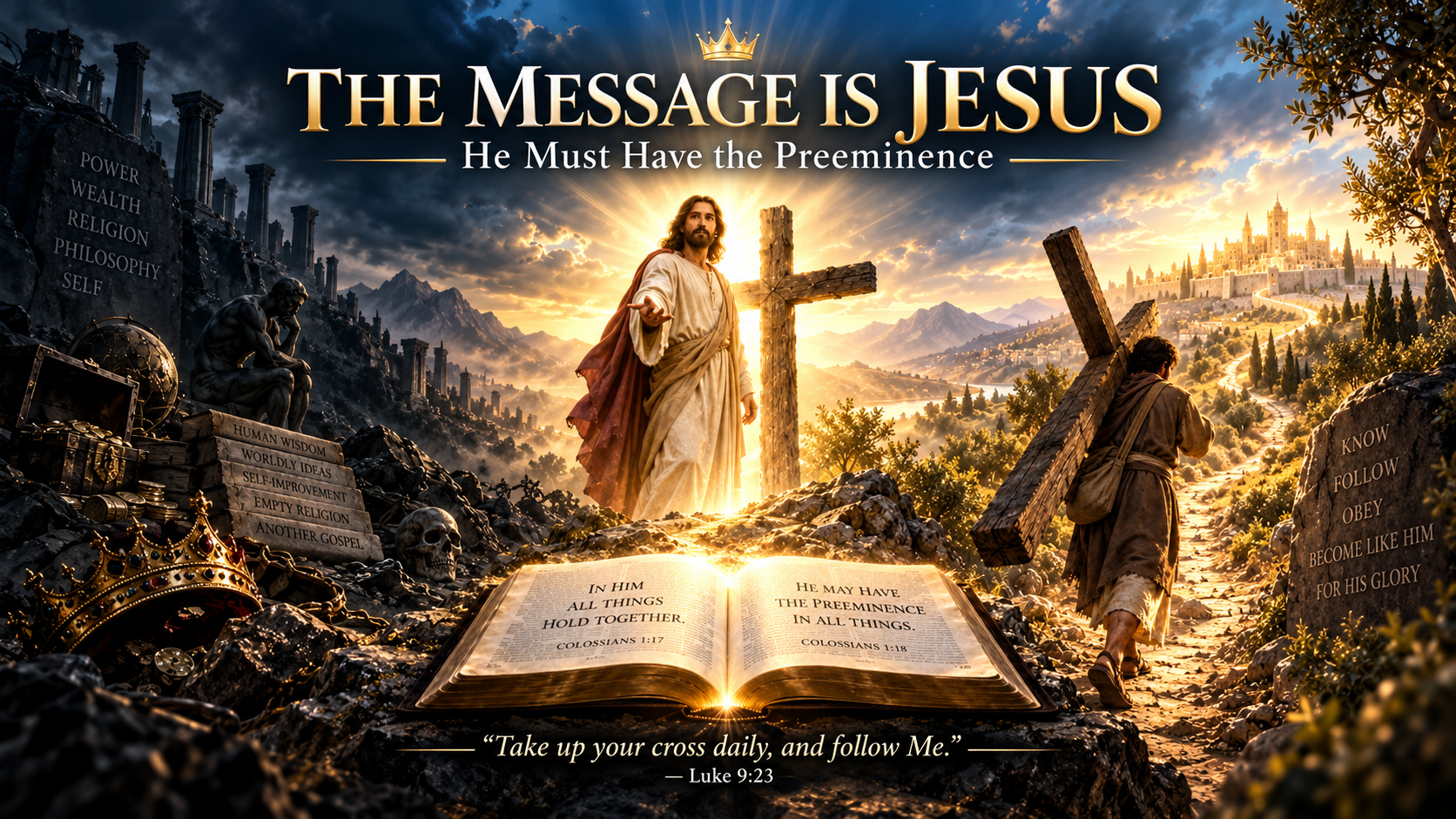
And the Jesus who went to the cross calls His followers to a cross as well. Jesus repeatedly said that anyone who would come after Him must deny himself, take up his cross, and follow Him. Luke records one additional word that makes the demand even more searching: DAILY.
The gospel does not merely invite us to believe something about Jesus. It summons us to lay down our lives and follow Jesus. That is why Paul could say that everything he once considered gain he now counted as loss for Christ. His great ambition was no longer position, reputation, achievement, or religious status. It was: “That I may know Him.”
That is Christianity reduced to its glorious essence.
Christ Must Have the Preeminence
Colossians tells us why nothing else can occupy the center. Everything was created through Christ and for Christ. He is before all things. In Him all things consist. He is the Head of the church.
And then Paul gives us the great conclusion: “That in all things He may have the preeminence.” Not prominence, but PREEMINENCE.
Christ is not supposed to be one important element among many important elements in the church. He is not another item on the ministry calendar. He is not a logo, slogan, doctrinal accessory, or closing reference after we have spent most of our time talking about ourselves. HE IS LORD.
Philippians 2 shows the astonishing path of Christ: He humbled Himself, took the form of a servant, became obedient unto death—even death on the cross—and therefore God highly exalted Him and gave Him the name above every name.
Every knee will bow. Every tongue will confess. Jesus Christ is Lord. If heaven gives Christ that place, how can the church give Him anything less?
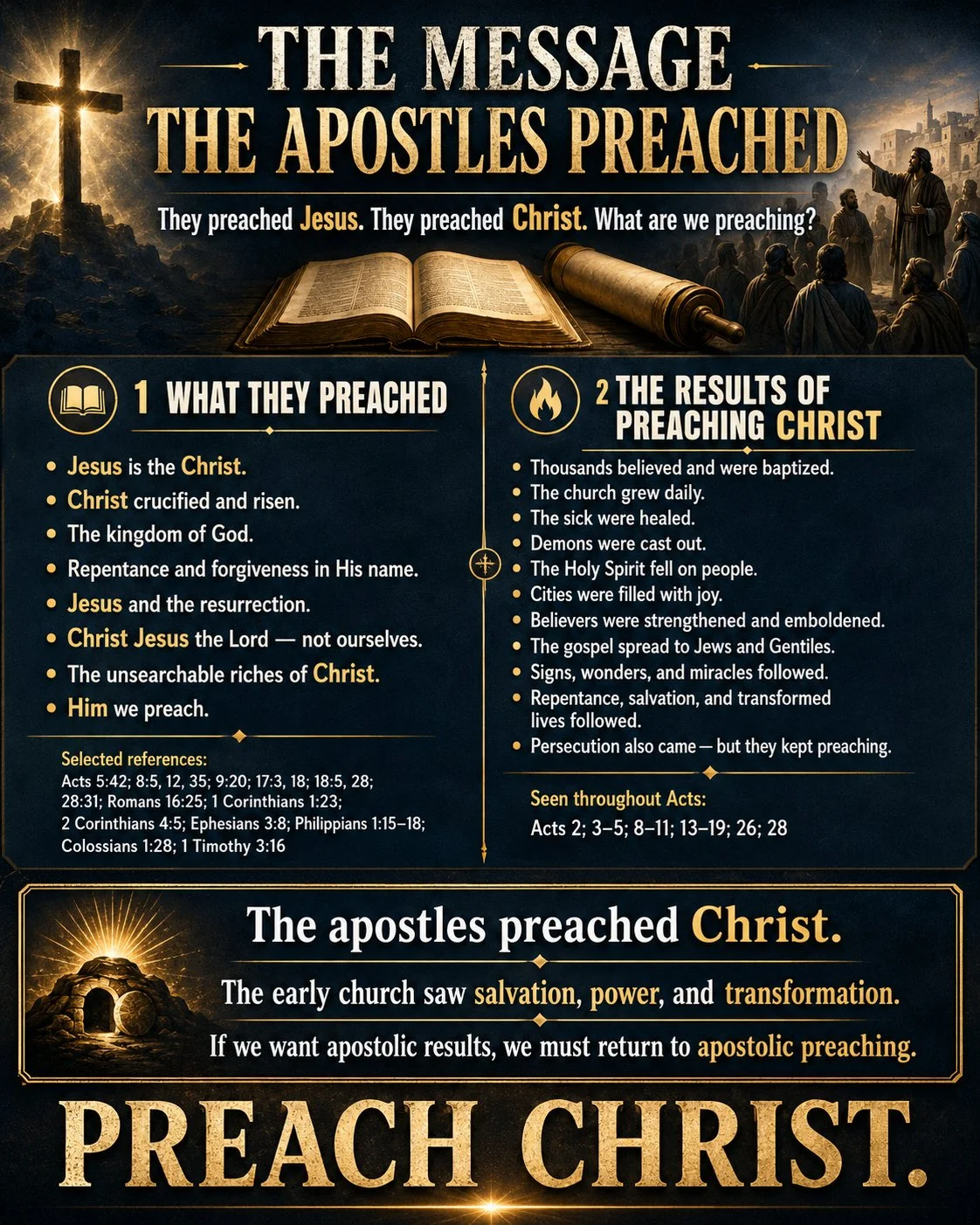
Look at What the Apostles Preached
The book of Acts makes the apostolic priority unmistakable. They “did not cease teaching and preaching Jesus as the Christ.”
Philip went to Samaria and “preached Christ.” When he encountered the Ethiopian official, Philip “preached Jesus to him.”
Paul entered the synagogues and preached that Jesus is the Christ and the Son of God. In Athens he preached “Jesus and the resurrection.”
Paul later summarized his ministry plainly: “We do not preach ourselves, but Christ Jesus the Lord.”
And Colossians reduces the apostolic mission to two words: “HIM WE PREACH.”
Notice what they were not preaching: Themselves. Their brands. Their personalities. Their institutions. Their political importance. Their latest strategy for attracting crowds. Topical sermons. Self-help talk. Personal and private interpretation of scripture. Their own Christian experience. They emptied themselves and only preached “JESUS.”
THEY PREACHED CHRIST: CRUCIFIED, BURIED, AND RISEN FROM THE DEAD.
And that raises an uncomfortable question for the modern church: What are we preaching?
If someone listened to our churches, ministries, conferences, podcasts, broadcasts, and social media for a month, would they conclude that Jesus Christ Himself is our consuming message? Or would they discover that He has gradually become supporting material for something else?
Jesus Preached Repentance, and So Did His Disciples
Returning Christ to the center also means recovering something frequently pushed to the edges of modern Christianity: REPENTANCE.
Jesus came preaching: “Repent, and believe in the gospel.”
John preached repentance.
Jesus sent His disciples out, and they preached that people should repent.
After the resurrection, Jesus told them that repentance and remission of sins should be preached in His name to all nations.
Paul told King Agrippa that his ministry called people to repent, turn to God, and do works befitting repentance.
Repentance is therefore not contrary to grace. It is part of the gospel response.
And when Jesus addressed the churches in Revelation, His message repeatedly included the same command: REPENT.
To Ephesus: repent and do the first works. To Pergamos: repent. To Sardis: hold fast and repent. To Laodicea: be zealous and repent.
Then comes the repeated warning: “He who has an ear, let him hear what the Spirit says to the churches.”
Revival, therefore, does not begin with louder music, larger crowds, better marketing, special services, special speakers, events, conferences, or greater political influence. Revival begins when God’s people hear Him, humble themselves, repent, and return to making Jesus the center of everything.
What Did Jesus Actually Send His Disciples To Do?
Jesus did not leave the mission ambiguous. He sent His disciples to preach the kingdom of God. He sent them to call people to repentance. He sent them to heal the sick. He told them to make disciples of all nations and teach them to obey everything He commanded. He told them to preach the gospel to every creature.
And before they went, He told them to wait until they were clothed with power from on high. Then Acts 1:8 gives the pattern: The Holy Spirit comes upon them, they receive power, and they become witnesses to Jesus.
The results recorded in Acts were extraordinary. The gospel spread. People repented. Lives changed. The sick were healed. Opposition arose. Churches were planted.
And eventually their enemies complained: “These who have turned the world upside down have come here too.”
That forces another difficult question upon us: What are we doing and what results are we producing? If our Christianity bears little resemblance to what Jesus commanded and the apostles practiced, the answer is not to redefine biblical Christianity. The answer is to return to it.
Remember Him
Jesus even gave His church a continual physical reminder of what must remain central. The bread and the cup. His body and His blood. “Do this in remembrance of Me.”
Paul says that whenever believers eat the bread and drink the cup, they proclaim the Lord’s death until He comes. The church repeatedly comes back to the cross.
We remember His body given for us. His blood shed for us. His covenant. His sacrifice. His return.
The Lord’s Table brings us back again and again to Jesus Christ and Him crucified.
THE CHURCH DOES NOT NEED ANOTHER REVIVAL, it must RETURN to JESUS who is the RESURRECTION and the LIFE.
Perhaps our greatest danger is not openly rejecting Jesus, but replacing Him with wrong versions of Jesus while continuing to use His name.
Paul warned that another Jesus could be preached. A different gospel could be accepted. A different spirit could be received. That warning should make every Christian, minister, church, and ministry examine itself.
Scripture is given not merely to comfort us but also to expose us, correct us, train us, and bring us back into alignment with God. Jesus told Laodicea that those He loves He rebukes and disciplines.
Correction is not rejection. Correction is evidence that Christ intends to bring His church back to Himself.
So the questions before us are simple: What are we preaching? What are we doing? What results are we seeing? Does Jesus Christ truly have the preeminence?
And the answer must be: We must preach the only message the Scriptures command us to preach.
The version of Jesus preached by the apostles: Jesus Christ crucified. Jesus Christ risen. Jesus Christ Lord. Jesus Christ preeminent.
We must preach Him. We must know Him. We must follow Him. We must take up our cross.
We must repent where we have departed from Him. We must listen again to what the Spirit is saying to the churches. And we must settle once and for all that nothing—nothing—will be permitted to take His place.