
YOU HONORED THEM MORE THAN ME
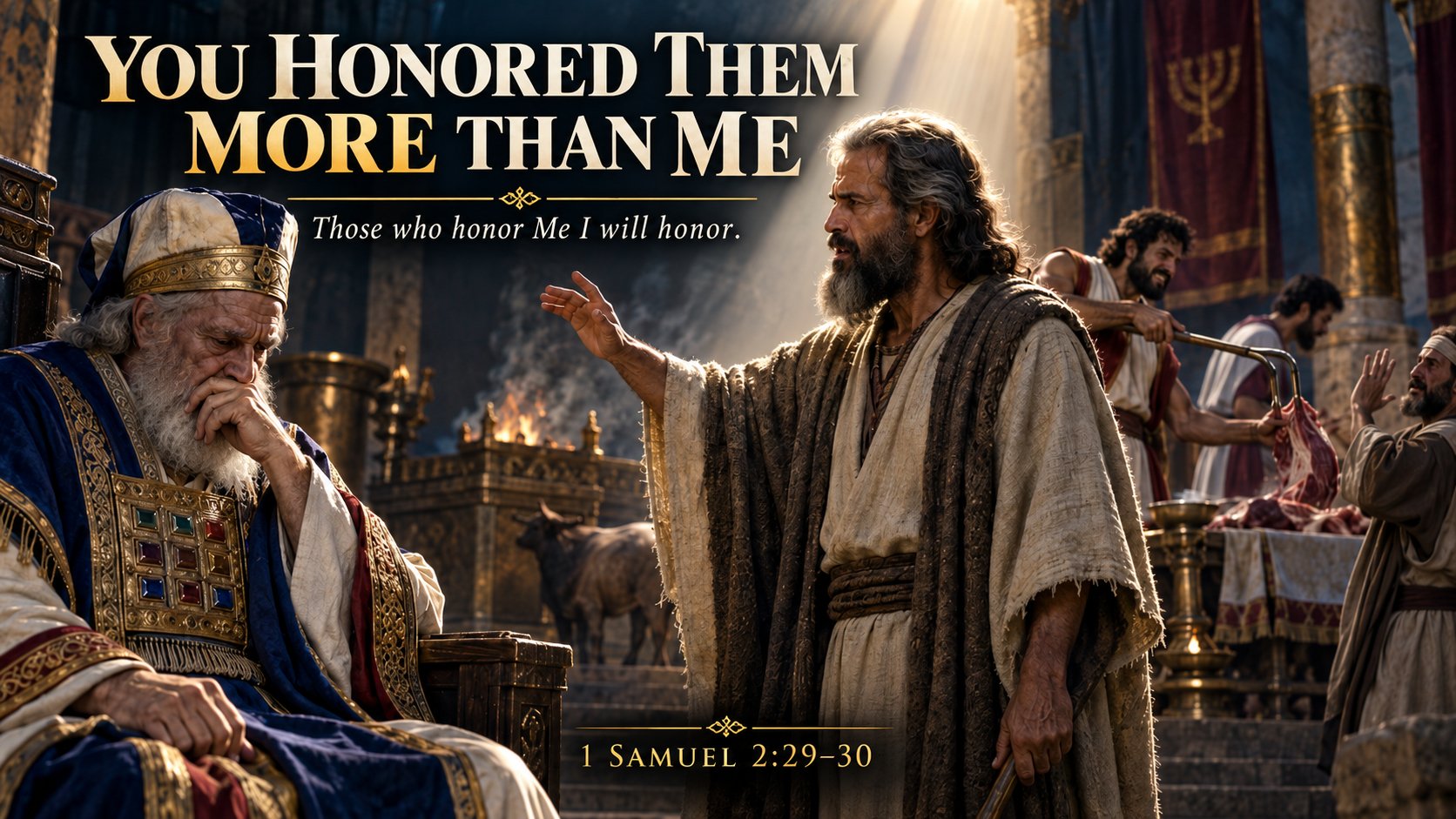
The story of Eli and his sons is not merely about corrupt priests. It is a warning about what happens when those entrusted with spiritual authority use it for themselves—and when those responsible for confronting evil instead choose to protect people, positions, or institutions.
In 1 Samuel 2, Scripture introduces Hophni and Phinehas with devastating clarity: “Now the sons of Eli were corrupt; they did not know the LORD.”
These were not outsiders attacking the priesthood. They were priests themselves. They held a sacred office, handled the sacrifices of God’s people, and served at the place where Israel came to worship. Instead of serving God and His people, they used the priesthood to satisfy themselves.
They took portions of the sacrifices that did not belong to them. They demanded meat before the fat had been offered to the Lord. When worshipers objected, their servants threatened to take it by force.
The priesthood had become a means of personal appetite. Lust for food, greed, power, sex, and personal profit over service. It was about using something sacred for personal benefit. Scripture says: “Therefore the sin of the young men was very great before the LORD, for men abhorred the offering of the LORD.”
That may be one of the most serious consequences of corrupt spiritual leadership. Their behavior did not merely damage themselves. It caused people to despise what belonged to God.
The sacrifices were holy. The worship was holy. God was holy.
But the men administering those things were corrupt, and their corruption led the people to recoil from the very things God had established for their good. That should sober anyone entrusted with spiritual leadership.
When ministry becomes a means of enrichment, personal glory, control, sexual gratification, influence, or self-promotion, something sacred is defiled. But the story does not end with Hophni and Phinehas. It moves to Eli. And this is where the passage becomes even more searching.
ELI KNEW
Eli was not unaware of what his sons were doing. Scripture says: “Now Eli was very old; and he heard everything his sons did to all Israel.”
He knew firsthand. He had heard the reports. He knew of their immorality. He knew they were abusing the priesthood. He even confronted them verbally: “Why do you do such things? For I hear of your evil dealings from all the people.”
Eli recognized that what they were doing was wrong, but recognition was not enough. Words were not enough. Eli held authority, yet he failed to use it to stop what he knew was evil. He rebuked his sons, but he allowed them to continue. God did not treat Eli’s passivity as neutrality. God held Eli responsible. That is what makes the rebuke that follows so powerful.
“YOU HONOR YOUR SONS MORE THAN ME”
God sent a man of God to Eli with this charge: “Why do you kick at My sacrifice and My offering which I have commanded in My dwelling place, and honor your sons more than Me?”
That is the heart of the passage. The greatest indictment against Eli was not merely that his sons were wicked. It was that when Eli was forced to choose between honoring God and protecting his sons, his actions revealed whom he valued more.
“You honor your sons more than Me.”
That statement extends far beyond Eli. It confronts every leader who sees wrongdoing yet refuses to act because doing so may strain a relationship. It confronts every ministry that protects a gifted leader because exposing the truth might damage the organization. It confronts every institution that prioritizes reputation over righteousness. It confronts every person who recognizes evil, speaks mildly against it, yet ultimately allows it to continue because decisive action would be uncomfortable, costly, or disruptive.
There is a profound difference between saying something is wrong and actually standing against it. Eli spoke, but Eli did not stop it. And heaven judged the difference.
You can condemn evil with your mouth while protecting it through your actions. You can say, “This should not be happening,” while continuing to preserve someone’s position, influence, authority, reputation, or access.
Eventually the question becomes unavoidable: Whom are you honoring more? God or the person you are unwilling to confront?
THE UNNAMED MAN OF GOD
One of the most compelling aspects of this passage is the man God chose to deliver the rebuke. Scripture does not give us his name. We are told nothing about his pedigree, position, reputation, education, history, or standing among the people. He simply appears in the text as “a man of God.”
Yet God sends this unnamed man to confront Eli—the high priest, judge, and one of Israel’s most significant spiritual and national leaders. That contrast should not be overlooked. The messenger had no recorded title, institutional position, or public stature to lend weight to his words. None of that mattered. His authority did not come from who he was before men, but from the Word of God he carried.
The messenger’s stature was irrelevant because the message was not his own. He stood before a man of immense religious and political authority and proclaimed God’s judgment: “Why… do you… honor your sons more than Me?”
Think about that. God did not send someone more famous than Eli. He did not send someone with a higher title. He did not send someone with greater institutional standing. He sent an unnamed man willing to speak what God had said. That remains a powerful truth.
God does not need someone prominent to confront someone prominent. Position does not determine spiritual authority. Reputation does not determine truth. Institutional stature does not determine whom God may choose to speak through. What matters is whether the Word being carried is His—and whether the person carrying it is willing to deliver it.
THOSE WHO HONOR ME
God then gives Eli a principle that extends far beyond that moment: “For those who honor Me, I will honor, and those who despise Me shall be lightly esteemed.”
That is the dividing line. Honor God above man.
Not family above God. Not position above God. Not institution above God. Not reputation above God. Not money above God. Not relationships above God. Not influence above God. Not personal comfort above God.
God had entrusted Eli with sacred authority, but Eli allowed personal attachment to interfere with obedience. His sons mattered more to him than confronting what dishonored God.
That is why this passage is about much more than the sins of Hophni and Phinehas. Their corruption is obvious. Eli’s failure is more subtle and is the most significant sin in this story. He knew the truth and spoke some of it, but when the moment came to act, he did not go far enough. And God exposed the real issue: “You honor your sons more than Me.”
THE QUESTION REMAINS
The temptation to honor people more than God did not end with Eli. It appears whenever we see something wrong yet remain silent because speaking may cost us. It appears whenever we excuse behavior because the person involved is powerful, gifted, important, influential, wealthy, loved, or useful. It appears whenever preserving an institution takes precedence over preserving righteousness. It appears whenever loyalty to a person outweighs loyalty to God.
Scripture does not allow us to hide behind the excuse that we privately disagreed. Eli disagreed. Eli rebuked his sons, yet God still held him accountable because he had authority to act and failed to use it. The lesson is severe but clear: Knowing about evil is not the same as confronting it. Speaking against evil is not the same as stopping what God has given you authority to stop. And protecting someone from the consequences of persistent evil can eventually become an act of dishonoring God Himself.
The question is therefore not simply whether we recognize what is wrong. The deeper question is: When obedience becomes costly, whom will we honor more?
God’s declaration still stands: “Those who honor Me, I will honor, and those who despise Me shall be lightly esteemed.”

