
THIRTY-TWO MONTHS IN THE TRENCHES: THE HARD TRUTHS HAVE ONLY GROWN HARDER
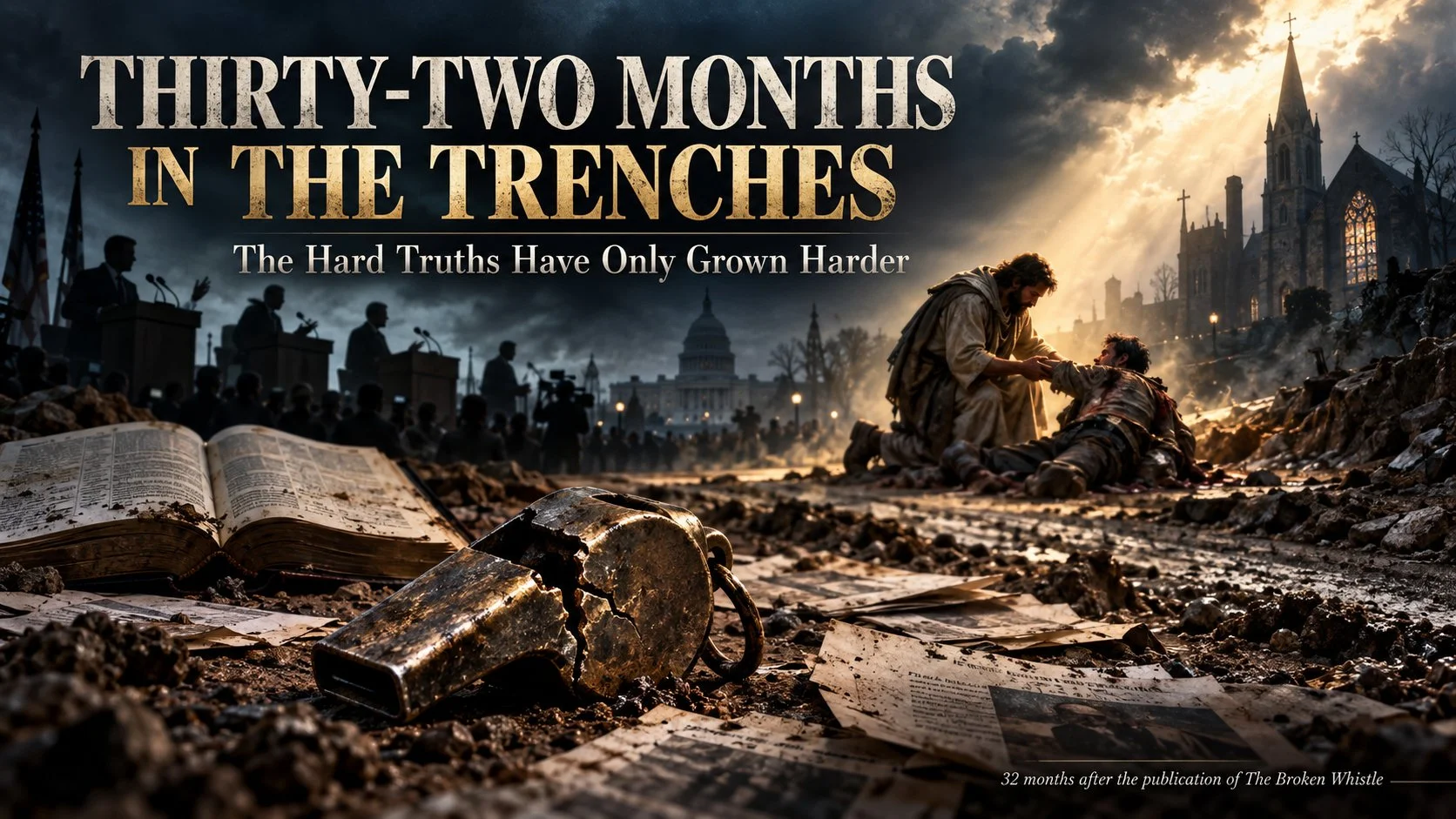
Thirty-two months after the publication of The Broken Whistle. “Truth will ultimately prevail where there is pains to bring it to light.”—George Washington
When I marked the first anniversary of The Broken Whistle: A Deep State Run Amok, I wrote about a truth Winston Churchill captured with brutal precision in The Gathering Storm: “The malice of the wicked was reinforced by the weakness of the virtuous.”
Twenty months later, that truth has not faded. It has hardened. The Broken Whistle entered the world on February 19, 2024. Thirty-two months have now passed. That is enough time to separate momentary enthusiasm from conviction, applause from sacrifice, rhetoric from action, and people who merely talk about courage from those willing to pay its price.
At the one-year mark, I asked a simple question: What are you doing? Today, the question is harder: Where are the WORKS? Jesus did not say, “Let your rhetoric so shine before men.” He said: “Let your light so shine before men, that they may see your good WORKS and glorify your Father in heaven.”—Matthew 5:16, NKJV
The imperative word is WORKS. That remains the beating heart of the matter.
Words are cheap. Outrage is cheap. Social-media posts, conferences, podcasts, political rallies, fiery sermons, television appearances, fundraising appeals, and chest-thumping declarations about “fighting evil” are cheap compared with standing beside a wounded human being when doing so costs something.
The first anniversary taught me that lesson. The next twenty months have driven it deeper.
THE RHETORIC GREW LOUDER. THE TEST DID NOT CHANGE
Leaders and activists on the political right still thunder from polished podiums, demanding that Americans rise, fight, stand firm, take back the country, defend liberty, expose corruption, resist tyranny, and refuse to compromise. Some mean it. Too many have turned righteous indignation into theater—rage for clicks, views, prominence, power, and money.
The fist pounds the podium. The crowd erupts. The cameras roll. The clip goes viral. And then what? Too often, nothing.
When the rally lights go dark and the wounded person standing behind the slogan needs actual help, the crusaders have already moved to the next stage, the next controversy, the next conference, the next fundraising appeal.
Meanwhile, those who actually did what everyone was told to do, those who rose, spoke, resisted, exposed, sacrificed, or blew the whistle, can find themselves standing alone in the wreckage.
That is not courage. That is spectator courage: celebrating sacrifice as long as someone else makes it. Crowds still gather to drink from the sensational rhetoric of self-crowned prophets while many of the actual warriors, bloodied, documented, scarred, and still standing, are left to carry the load alone.
THE RECORD HAS GROWN STRONGER
Something important has changed since the first-anniversary article. The public record surrounding The Broken Whistle has grown substantially.
Between August and October 2026, multiple press releases brought renewed attention to the book and its extensive documentary foundation. Independent reviewers focused not merely on its political arguments, but on the depth of the contemporaneous record beneath them.
The Prairies Book Review called it a “fiery, unsettling insider account of whistleblowing, institutional power, and the steep price of dissent.” It described the book as “dense with documentation but propelled by personal conviction” and “an urgent, combative account of conscience colliding with bureaucracy.” Then came the comparison: “Fans of hard-hitting insider memoirs such as Edward Snowden’s Permanent Record and Bill Browder’s Red Notice will find plenty to admire in this memoir.”
BookView Review independently reached much the same conclusion, describing The Broken Whistle as a “painstakingly documented account” and “a document-rich, intensely personal reckoning with secrecy, power, and the battle to put one’s story on the record.”
IndieReader, Literary Titan, The Book Revue, Reedsy Discovery/San Francisco Book Review, and others have likewise examined the book and underscored different dimensions of its story: whistleblowing, institutional power, leadership, retaliation, conscience, government accountability, and the extraordinary cost that can accompany dissent.
That matters, not because book reviews heal wounds, not because awards correct injustice, and not because press releases substitute for accountability. They do not. What matters is that the documentary record is escaping the bureaucratic graveyard. That was one of my principal reasons for writing the book.
In my October 2, 2026 BookView Author Interview, I explained that I had spent years attempting to work through the mechanisms the government itself established for reporting alleged wrongdoing and retaliation. When those mechanisms failed, I became convinced that the documentary record was too important to disappear inside a bureaucracy.
I said: “Our constitutional republic is far more fragile than many people realize. It depends on robust oversight, accountable institutions, and citizens who remain informed and engaged in government rather than assuming someone else will safeguard it for them.”
And at the core of the book is another crucial distinction: “The Broken Whistle is not merely a memoir. It is also a documented case history.”
My ultimate loyalty, I explained, “was never to an agency or bureaucracy. It was to the United States of America and our constitutional republic.”
The record is growing, the documentation is being examined, and the story is reaching farther. But here is the uncomfortable truth: Recognition is not rescue.
A glowing review cannot stand beside a wounded whistleblower. A press release cannot rebuild a destroyed career. A social-media share cannot replace courage. And applause after someone survives the battlefield is not the same thing as entering the battlefield to help him while the bullets are still flying.
LOOK BEYOND MY STORY
This is bigger than The Broken Whistle. Look across the broader field of the wounded.
On January 20, 2025, President Donald Trump granted full pardons to the January 6 defendants not specifically named for commutation, commuted the sentences of fourteen others to time served, directed dismissal of pending cases, and ordered the immediate release of those still imprisoned.
Whatever one believes about January 6, that presidential action ended one chapter for many people. It did not erase what came before it. It did not restore lost years. It did not automatically repair marriages, replenish savings accounts, restore businesses, remove trauma from children, or undo years of legal battles, incarceration, public vilification, financial ruin, and social isolation.
Where was the army of people who had spent years shouting about them? Some individuals and grassroots organizations did extraordinary work. They deserve credit. But the larger lesson remains. The volume of rhetoric was far greater than the durability of sacrifice. Too many discovered that being useful to a political narrative is not the same thing as being loved as a neighbor.
THEN LOOK AT OUR SERVICE MEMBERS
The same question confronts us when we examine the service members separated from the military after refusing the COVID-19 vaccine mandate. Nearly 8,700 were involuntarily separated under that policy. Many more saw their careers truncated or damaged when they left rather than comply, or when the process itself became the punishment.
On January 27, 2025, an executive order created a pathway for eligible former service members to return at their previous rank and receive back pay, benefits, and compensation. Additional Defense Department actions addressed reinstatement, records corrections, discharge characterizations, and associated benefits. In March 2026, the Department extended reinstatement and return-to-service guidance through April 1, 2027, while continuing efforts to address records and benefits for affected veterans.
Government should correct injustice when it recognizes injustice. Yet the process has been slow, bureaucratic, and incomplete for many. Years of lost careers, disrupted finances, benefits disputes, and uncertainty do not disappear because an order was signed.
But again I ask: Where was the ecclesiastical army?
Where were the people who thundered about religious liberty? Where were the voices shouting about bodily autonomy? Where were those who proclaimed their undying support for America’s warriors?
Where was the organized, sustained infrastructure to help military families navigate lost careers, disrupted finances, benefits disputes, reintegration, paperwork, appeals, and years of uncertainty?
There were exceptions. There always are.
My indictment is not that nobody helped. My indictment is the grotesque disparity between the volume of the rhetoric and the depth of the sacrifice.
That is the pattern. Talk loudly. Raise money. Build audiences. Demand that ordinary people stand. And when ordinary people actually stand and get crushed for it, walk past them on the Jericho road.
The pattern is the same for those who used the authorized channels the government itself created.
THE ECCLESIASTICAL CLASS
I have used the phrase “Ecclesiastical Class” deliberately.
I am not speaking of every pastor, every church, or every Christian leader. There are faithful men and women quietly serving people every day who will never have television programs, enormous platforms, political influence, or celebrity followings.
I am speaking about a particular class of religious personalities and institutions that has intertwined Christianity with political influence, public visibility, access, fundraising, celebrity, and power, while repeatedly invoking righteousness as its justification.
To that class, I repeat what I wrote at the one-year mark: Stop the hypocritical posturing. It’s not what you say and how many photo-ops you can produce; it’s what you really do deep down in the trenches of this war.
After more than seven years in Tulsa, Oklahoma, my assessment has not softened. Tulsa was once swaggeringly called “Tulsarusalem.” What I have encountered instead too often resembles a hollow echo of the decadent papal Rome that preceded Martin Luther—a religious establishment rich in words, institutions, personalities, networks, and influence, yet capable of walking straight past the wounded man lying beside the road. The same pattern appears on national platforms and in national networks.
The Ecclesiastical Class has offered me, my fellow whistleblowers, J6 prisoners and their families, and veterans affected by the COVID-19 mandates, little of substance. No sustained institutional aid. No durable solidarity. No army assembled around the principle they so loudly preach. And this despite years of proclamations about righteousness, corruption, government accountability, persecution, religious liberty, and the need for believers to “rise.”
I rose. Others rose. That is where the test began.
A non-disclosure agreement still restricts what I can publicly say about certain matters. That makes the written record, and the material that can lawfully be placed before the public, even more important.
But the larger pattern is nationwide.
Whistleblowers. January 6 defendants and their families. Service members separated over the vaccine mandate. People who challenged powerful institutions. Men and women encouraged to “stand” by leaders who somehow disappeared when standing produced consequences.
Again and again, the priest walks past. Again and again, the Levite crosses the road.
And sometimes the vultures arrive afterward, willing to display the wounded person as a prop if his suffering can generate attention, influence, donations, subscriptions, clicks, or political capital.
Exploitation masquerading as mercy is still exploitation.
THE GOOD SAMARITAN DID NOT ISSUE A STATEMENT
This is why the Good Samaritan remains such a devastating indictment of religious hypocrisy. He did not organize a conference about the wounded man. He did not livestream from the side of the road. He did not denounce the robbers before returning to his comfortable life. He did not tell the wounded man, “I’m praying for you,” and keep walking.
He stopped. He descended into the dirt. He treated the wounds. He lifted the man onto his own animal. He transported him. He paid. And he promised to return. That is what love looked like.
WORKS. There is that word again. The priest had theology. The Levite had religion. The Samaritan had works.
THIRTY-TWO MONTHS LATER, THE VERDICT IS HARDER
Can we smash the chains of wickedness? Only if people who claim to believe in righteousness finally decide that righteousness requires something from them. Martin Luther King Jr. said: “The time is always right to do what is right.”
James 4:17 puts it more severely: “So then, if we do not do the good we know we should do, we are guilty of sin.”
And then there is the famous warning often attributed to Dietrich Bonhoeffer—although scholars have been unable to establish that he actually wrote it: “Silence in the face of evil is itself evil. God will not hold us guiltless. Not to speak is to speak. NOT TO ACT IS TO ACT.” Read that last sentence again. NOT TO ACT IS TO ACT.
Inaction is not neutral. Walking past the wounded is a decision. Seeing injustice and protecting your platform instead is a decision. Knowing what is right and calculating that doing it might cost too much is a decision. Watching another person absorb the blows while shouting encouragement from behind the barricade is a decision.
When those who cloak themselves in righteousness prove too weak, too frightened, too self-interested, or too intoxicated by optics to act, Churchill’s warning becomes reality: “The malice of the wicked was reinforced by the weakness of the virtuous.” That is not merely history. That is a diagnosis.
THE QUESTION IS NO LONGER WHETHER THE WHISTLE IS BROKEN
Thirty-two months later, perhaps the deepest lesson has changed. The question is no longer simply whether the whistleblower system is broken. I documented my answer to that question.
The harder question now is: What happens when the whistle is blown, the evidence is placed on the table, the wounded are visible, the cries are heard, and the people who claim to stand for righteousness still refuse to move?
There comes a point when ignorance is no longer an excuse. There comes a point when delay becomes a choice. There comes a point when rhetoric without action becomes hypocrisy. There comes a point when the priest and Levite can no longer pretend they did not see the man beside the road. Thirty-two months have passed. The record is public. The reviews are accumulating. The evidence remains. The wounded are still here. The excuses are old.
So rise. But this time, do not rise for the cameras. Rise to work. Rise to sacrifice. Rise to defend the person who cannot advance your career. Rise to help the person whose name will not increase your audience. Rise when there is no applause. Rise when helping costs money. Rise when it costs influence. Rise when it costs access. Rise when it costs reputation.
Be the Good Samaritan. Get down into the muck of the Jericho road. Bind the wounds. Carry the load. Pay the price. Come back tomorrow. Stop telling everyone else to fight battles you are unwilling to enter yourself. Stop mistaking outrage for courage. Stop confusing performance with righteousness.
Shut the mouths of empty rhetoric long enough to do the WORK.
Because if the righteous will not act, wickedness does not need to defeat us. We will have already surrendered.
When the Son of Man returns, the metric will not be the number of events with photo ops, the number of times you spoke, the number of times you prayed publicly for the president, the number of times worship was staged at the White House, the number of political television broadcasts you made, or the number of prophecies you issued about the election. Those things will not be the measure. The measure will be how far down into the muck of life you were willing to go to aid the wounded—the hungry, the stranger, the naked, the sick, the imprisoned—when doing so cost you something and advanced no audience, no platform, and no career.
Matthew 25:31-46 NKJV: The Son of Man Will Judge the Nations
31 “When the Son of Man comes in His glory, and all the holy angels with Him, then He will sit on the throne of His glory.
32 All the nations will be gathered before Him, and He will separate them one from another, as a shepherd divides his sheep from the goats.
33 And He will set the sheep on His right hand, but the goats on the left.
34 Then the King will say to those on His right hand, ‘Come, you blessed of My Father, inherit the kingdom prepared for you from the foundation of the world:
35 for I was hungry and you gave Me food; I was thirsty and you gave Me drink; I was a stranger and you took Me in;
36 I was naked and you clothed Me; I was sick and you visited Me; I was in prison and you came to Me.’
37 “Then the righteous will answer Him, saying, ‘Lord, when did we see You hungry and feed You, or thirsty and give You drink?
38 When did we see You a stranger and take You in, or naked and clothe You?
39 Or when did we see You sick, or in prison, and come to You?’
40 And the King will answer and say to them, ‘Assuredly, I say to you, inasmuch as you did it to one of the least of these My brethren, you did it to Me.’
41 “Then He will also say to those on the left hand, Depart from Me, you cursed, into the everlasting fire prepared for the devil and his angels:
42 for I was hungry and you gave Me no food; I was thirsty and you gave Me no drink;
43 I was a stranger and you did not take Me in, naked and you did not clothe Me, sick and in prison and you did not visit Me.’
44 “Then they also will answer Him, saying, ‘Lord, when did we see You hungry or thirsty or a stranger or naked or sick or in prison, and did not minister to You?’
45 Then He will answer them, saying, ‘Assuredly, I say to you, inasmuch as you did not do it to one of the least of these, you did not do it to Me.’
46 And these will go away into everlasting punishment, but the righteous into eternal life.”
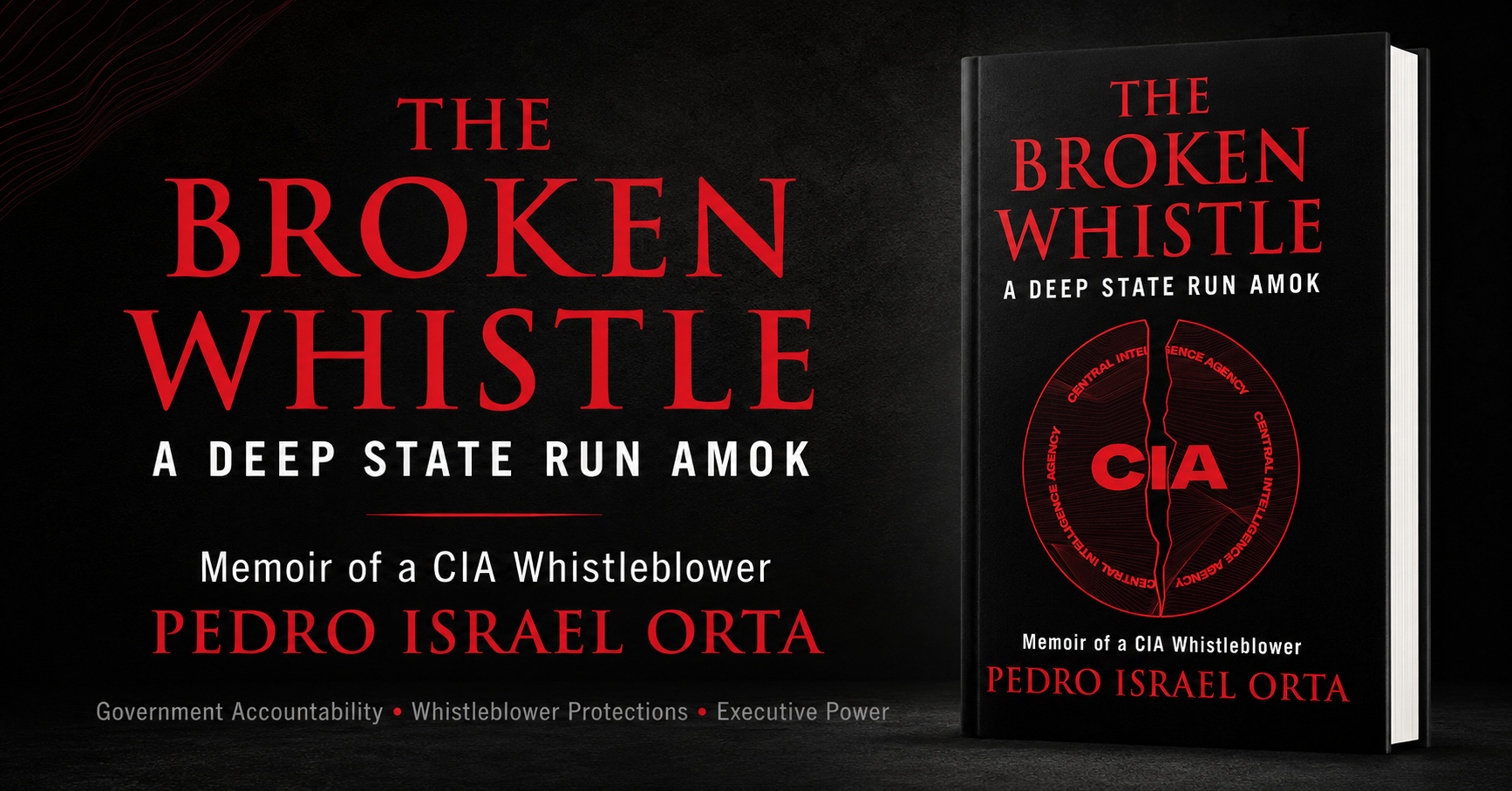
The Broken Whistle: A Deep State Run Amok remains available online, with Amazon still the primary purchasing option. The 34-minute documentary The Broken Whistle is available on SalemNOW, alongside the longer film Deep State Gangsters. The growing collection of independent reviews, interviews, visual case studies, documentary productions, and supporting material continues to expand the public record for anyone willing to examine it.
The whistle has been blown. The question now is who will actually move.

