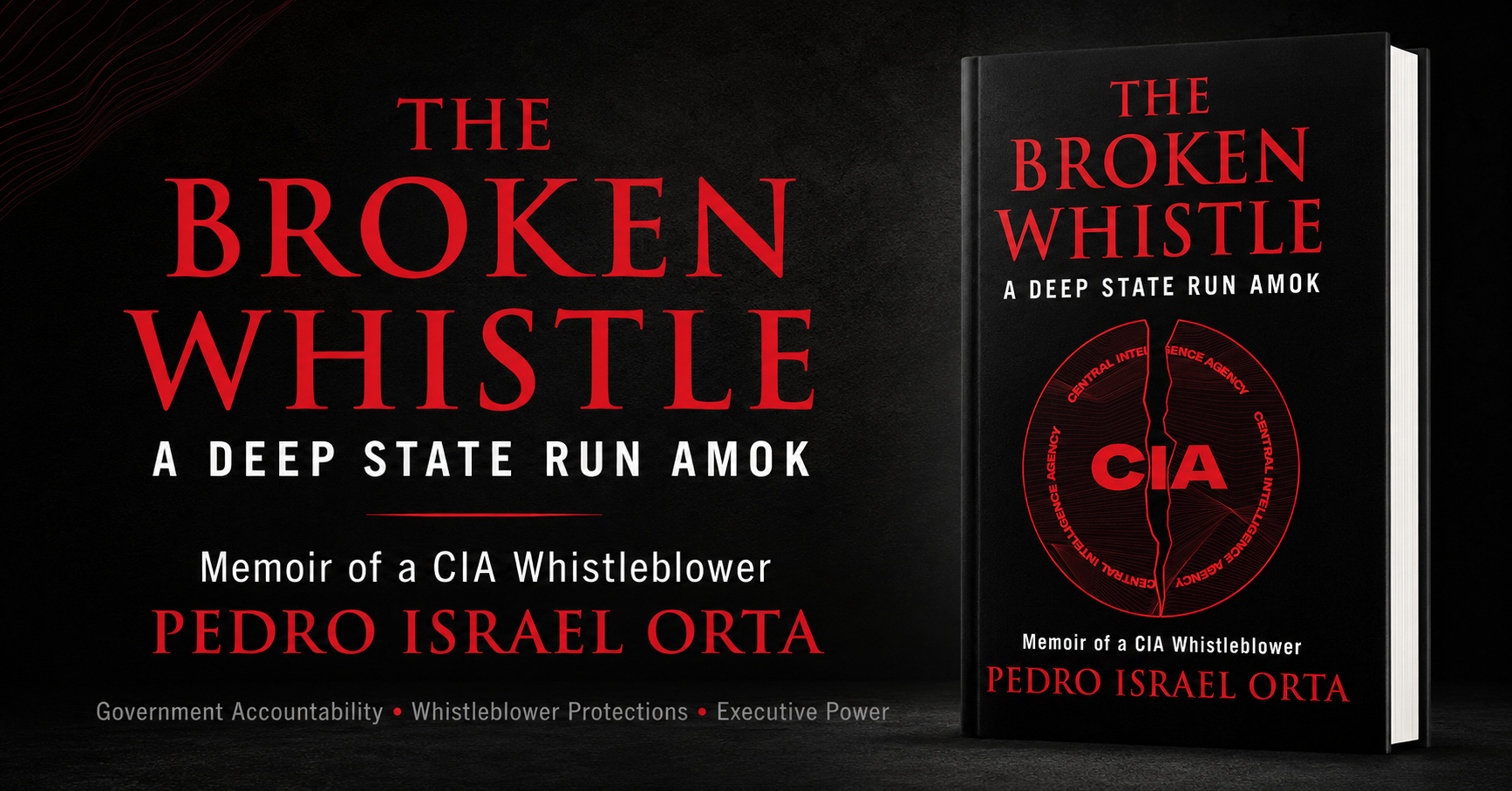
A TURNING POINT FOR “THE BROKEN WHISTLE”
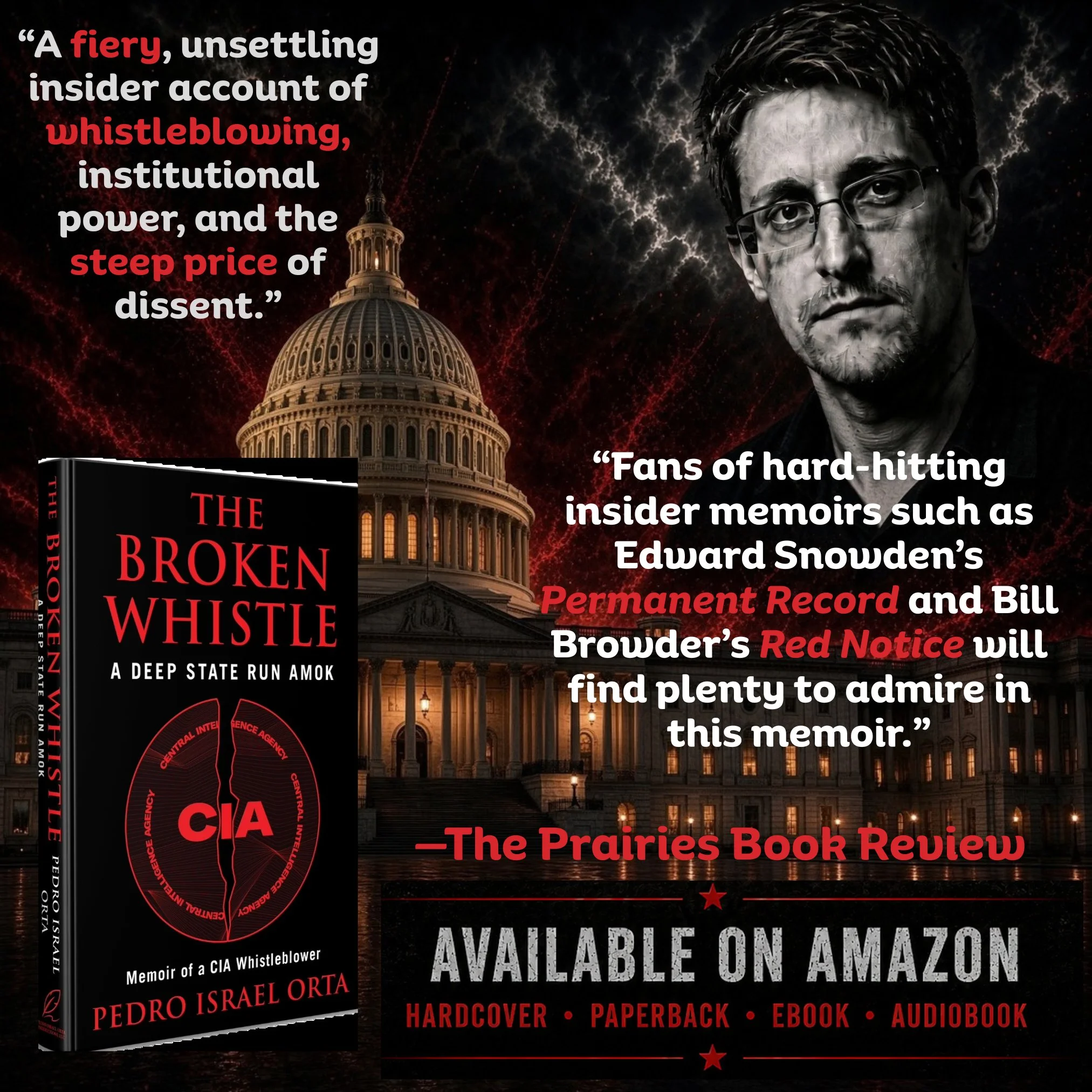
An independent review comparing The Broken Whistle to Edward Snowden's Permanent Record and Bill Browder's Red Notice has opened a new chapter in the book's journey—and expanded its visibility well beyond its original audience.
Every book has moments in its life that seem more significant than others. For The Broken Whistle, this past week may prove to be one of them.
On October 5, EIN Presswire distributed a release centered on the latest independent critical assessment of my book: “New Review Compares Former CIA Officer's Book to Snowden's Permanent Record and Browder's Red Notice.” Read the full press release in this hyperlinked text.
That comparison matters to me—not because The Broken Whistle tells the same story as either of those books. It does not. What matters is the literary and subject-matter company in which an independent reviewer chose to place it.
Snowden's Permanent Record has become one of the best-known modern accounts involving intelligence, secrecy, government power, and dissent. Browder's Red Notice brought an extraordinary personal confrontation with institutional and governmental power to an international readership.
The Broken Whistle approaches these questions from a very different direction.
My story is fundamentally about what happened when I attempted to work within the system—reporting wrongdoing through authorized channels, relying upon established whistleblower protections, and expecting the oversight institutions created to protect those processes to function as intended.
More Than One Review
What makes this moment particularly significant is that The Prairies Book Review does not stand alone.
A pattern has begun to emerge across independent reviews.
The Prairies Book Review described the book as a “fiery, unsettling insider account of whistleblowing, institutional power, and the steep price of dissent.” It also called the book “dense with documentation but propelled by personal conviction” and an “urgent, combative account of conscience colliding with bureaucracy.”
BookView Review called it a “painstakingly documented account” and “a document-rich, intensely personal reckoning with secrecy, power, and the battle to put one's story on the record.”
IndieReader described it as “a courageous and very detailed account of holding onto integrity despite coming under intense pressure from the CIA.”
Literary Titan awarded the book five stars.
The Book Revue called it “essential and deeply unsettling reading” for readers seeking to understand how power operates inside the Intelligence Community.
And Philip Zozzaro, writing for Reedsy Discovery/San Francisco Book Review, called it “a stand-out exposure of the haphazard organization of the Central Intelligence Agency.”
Different reviewers. Different perspectives. Yet remarkably similar themes continue to surface: Documentation. Institutional power. Conscience. Integrity. Accountability. And the consequences of dissent. That is significant because those themes are precisely why I wrote the book.
Professionally Produced, Independently Published
There is another part of this journey worth recording. Although The Broken Whistle was independently published, it was professionally developed from manuscript to finished book. I deliberately assembled an experienced team with backgrounds in traditional publishing, memoir, nonfiction, intelligence literature, and book design.
Veteran editor Steve Gansen, whose publishing career spans nearly three decades and more than 100 books, provided editorial assessment and professional copyediting. His work includes Floyd L. Paseman's A Spy's Journey: A CIA Memoir, a book later reviewed by The New York Times Book Review, Library Journal, and the CIA's professional journal, Studies in Intelligence.
UK-based editor, author, publishing professional, and former literary agent David Haviland brought more than two decades of industry experience to an additional professional review of the manuscript.
Veteran book designer David Ter-Avanesyan created the book's cover and visual identity. His more than 20 years of professional experience includes work for Simon & Schuster, St. Martin's Press, Basic Books, McGraw-Hill, and Skyhorse Publishing, including approximately eleven years at Simon & Schuster, where he rose to senior designer.
That distinction matters to me. Independent publishing described the method of publication; it did not mean lowering the professional standard of the book. From editorial development and copyediting through proofreading and design, my objective was to produce The Broken Whistle to the standards expected of serious narrative nonfiction.
The Story Is Traveling
The EIN Presswire release has also begun extending that conversation beyond the book-review ecosystem. The release has been indexed, syndicated, republished, and transformed into derivative coverage across multiple platforms and geographic markets. Some of those appearances are straightforward press-release syndication; others have provided additional framing and commentary. That distinction matters. I do not consider every press-release mirror to be independent journalism, nor should anyone else. But taken collectively, the growing distribution demonstrates something important: The story is traveling.
Readers encountering The Broken Whistle today may discover it through a book review, a news search, a syndicated release, an international publication, a documentary, an interview, or one of the visual case studies developed from the book. That is considerably different from where this project began.
Why I Wrote It
Ultimately, however, visibility was never the principal reason for writing The Broken Whistle. I spent eighteen and a half years inside the U.S. Intelligence Community. I served in Iraq, Afghanistan, and other high-threat environments. I worked intelligence operations, counterterrorism, counterintelligence, targeting, liaison, strategic analysis, and executive-level briefing. I later served as an Intelligence Community inspector working on whistleblower matters.
I saw extraordinary people perform extraordinary service. I also saw what can happen when institutions fail to police themselves. The book therefore asks a question larger than what happened to one CIA officer: What happens to a constitutional republic when the mechanisms created to expose wrongdoing, protect dissent, and hold powerful institutions accountable cease to function as intended?
That question is why the documentary record matters. It is why I included correspondence, policies, complaints, timelines, and other records throughout the book—so readers do not have to accept my conclusions simply because I wrote them. They can examine the evidence and reach their own. And it is why the recent critical recognition means something to me. Not because every reviewer agrees with every conclusion I have reached. They don't need to. What matters is that independent readers and reviewers are increasingly recognizing that the underlying story deserves serious consideration.
A New Chapter
I don't know where The Broken Whistle ultimately goes from here. Perhaps this moment will lead to a larger publisher. Perhaps it will bring the book before readers who otherwise would never have encountered it. Perhaps journalists, scholars, government officials, or future whistleblowers will find something useful in its pages. Those chapters have not yet been written. But I do know this: A book that began as my attempt to put a difficult chapter of American Intelligence Community history on the record is increasingly finding an audience beyond the one I could create for it myself.
For an independent author confronting powerful institutions and telling an uncomfortable story, that is no small thing. And that makes this moment worth recording.
Pedro Israel Orta—Author, The Broken Whistle: A Deep State Run Amok.