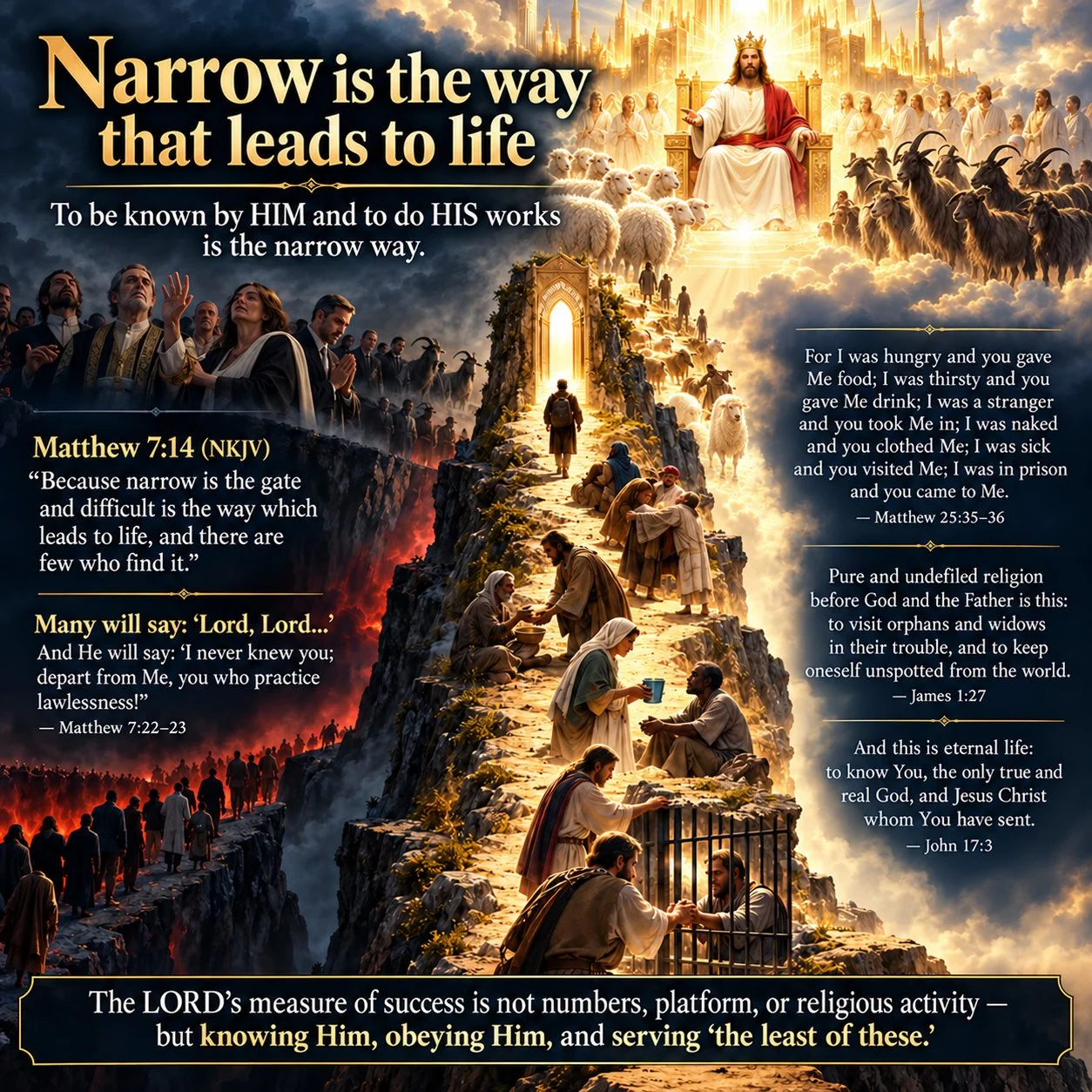

“Because narrow is the gate and difficult is the way which leads to life, and there are few who find it.” — Matthew 7:14
A sobering possibility confronts the modern Church: we may be measuring success by standards Jesus never gave us. We count attendance, salvations, baptisms, campuses, and church plants. We count students, followers, views, likes, subscribers, impressions, downloads, conferences, crusades, books sold, money raised, buildings constructed, and nations reached. We package the numbers into annual reports and call it Kingdom success.
But when Jesus described the Day when men and women would stand before Him, He did not emphasize those metrics. That should sober every one of us.
The narrow way is not merely about claiming the name of Jesus. It is not about proximity to Christian activity. It is not even about feats of power such as signs, wonders, and miracles. The narrow way is about knowing Him, being known by Him, obeying Him, and becoming the kind of person whose life demonstrates that relationship. Jesus warned that many religious people may discover the distinction far too late.
“Lord, Lord…”
Matthew 7 contains some of the most disturbing words Jesus ever spoke. “Many will say to Me in that day, ‘Lord, Lord, have we not prophesied in Your name, cast out demons in Your name, and done many wonders in Your name?’” These are not atheists. They know the language and call Him Lord. They claim prophetic and deliverance ministries, miracles, and supernatural works. By many modern Christian standards, they would be highly successful ministers. Imagine the promotional material: prophetic ministry, demons cast out, signs and wonders, powerful manifestations.
And yet Jesus responds: “I never knew you; depart from Me, you who practice lawlessness!” That demolishes the assumption that visible spiritual activity automatically proves intimacy with God. It is possible to engage in religious activity without a relationship. It is possible to know the vocabulary without knowing Jesus. It is possible to invoke His name while refusing His rule. It is possible to impress people and still fail the only test that matters.
Jesus does not say, “I knew you once.” He says, “I never knew you.” That is the issue. Not platform. Not gifting. Not notoriety. Not manifestations. Relationship.
Being Around Jesus Is Not the Same as Knowing Jesus
Luke 13 gives another warning. Some will say, “We ate and drank in Your presence, and You taught in our streets.” In modern language: “We attended the meetings. We heard the preaching. We were there when You moved. We belonged to the right circles. We sat under great teaching. We were part of the movement. We faithfully attended church, conferences, and other meetings.”
Proximity to the things of God is not the same as surrender to God. You can sit in church for forty years and never truly yield your life to Christ. You can attend conferences, quote great preachers, carry the right Bible, sing the songs, raise your hands, and learn Christian vocabulary, yet your heart remains untouched by the One you claim to worship.
Jesus’ answer is devastating: “I tell you I do not know you…” Again, the issue is relationship. Does He know you? Do you know Him?
John 17:3 gives Jesus’ definition of eternal life: “And this is eternal life: [it means] to know… You, the only true and real God, and… Jesus Christ… Whom You have sent.” Eternal life is not first presented as a religious résumé. It is knowing God. Not merely knowing about Him. Not merely studying theology about Him. Not merely speaking for Him. Knowing Him. Walking with Him. Hearing Him. Obeying Him. Loving what He loves. Rejecting what He rejects. Becoming increasingly conformed to His character.
That is the narrow road.
Then Jesus Tells Us What the Fruit Looks Like
This is where Matthew 25 becomes uncomfortable. Jesus describes His return in glory and His sitting upon His throne. The nations are gathered before Him. Then comes the separation. Sheep on His right. Goats on His left.
Notice what He highlights. He does not say: “You held 5,000 church services. You founded twelve ministry schools. You trained 20,000 students. You planted 300 churches. You accumulated two million followers. You preached to stadiums. You produced viral sermons. You built an international network. You became the most recognized Christian leader of your generation.”
No. He says: “I was hungry and you gave Me food. I was thirsty and you gave Me drink. I was a stranger and you took Me in. I was naked and you clothed Me. I was sick and you visited Me. I was in prison and you came to Me.”
The King of Glory identifies Himself with people the world routinely overlooks: the hungry, the thirsty, the stranger, the poor, the sick, and the prisoner—the least. Then He says: “Inasmuch as you did it to one of the least of these My brethren, you did it to Me.”
Do not rush past that sentence. Jesus takes our treatment of people personally. Very personally.
We Have Built the Wrong Scoreboard
This does not mean preaching is unimportant. It does not mean evangelism, discipleship, churches, schools, missions, or supernatural ministry are unimportant. Jesus Himself commanded us to make disciples. The Gospel must be preached. Churches matter. Teaching matters. Prayer matters. The gifts of the Spirit matter.
But here is the danger: we can turn means into metrics and metrics into idols. Numbers can become substitutes for fruit. Platforms can become substitutes for character. Influence can become a substitute for obedience. Public ministry can become a substitute for private holiness. Religious success can become a way to avoid the far harder question: What does Jesus think of my life?
A ministry can grow while a soul shrivels. A preacher can gain followers while losing tenderness. A leader can become famous while becoming less like Christ. A church can build buildings while walking past broken people. A church can increase attendance yet not grow as defined by the Scriptures. A movement can boast of reaching nations while ignoring the widow down the street.
We should be willing to ask whether some of what we call Kingdom success is simply worldly ambition wearing Christian clothing.
James Was Equally Direct
James 1:27 says: “Pure and undefiled religion before God and the Father is this: to visit orphans and widows in their trouble, and to keep oneself unspotted from the world.”
Notice the two dimensions: compassion and holiness. Care for those in trouble and refuse conformity to the world. That destroys two opposite distortions. Christianity is not merely social action without holiness, nor is it merely personal holiness without compassion. The narrow road contains both: a clean heart and dirty hands.
Hands dirty because they have been serving people who cannot repay you. People who cannot expand your platform. People who cannot introduce you to influential friends. People who cannot donate enough money to fund your annual report. People who may never even say thank you.
That kind of service reveals something. It reveals whom we are actually serving.
The Least of These Are Not Good for Branding
That may be exactly why Jesus chose them. Feeding someone who is hungry may never go viral. Visiting someone in prison is unlikely to grow your audience. Sitting with someone who is sick may yield no measurable return. Helping a widow does not automatically build a brand. Caring for an orphan may cost far more than it returns. Welcoming a stranger may inconvenience you.
This kind of Christianity is frequently hidden. Quiet. Costly. Unmarketable. But Heaven sees it.
Perhaps some of the greatest ministries on earth are known to almost no one. The elderly woman praying every morning for her neighborhood. The man anonymously buying groceries for a struggling family. The believer visiting a forgotten prisoner month after month. The couple caring for foster children when no one is applauding. The pastor tending faithfully to fifty people while another minister with fifty thousand followers receives the headlines. The Christian sitting beside a dying stranger. The person who gives when there is no camera.
Heaven has a different scoreboard.
Do Not Misread This: Works Do Not Replace Christ
There is another ditch we must avoid. Matthew 25 does not give permission to replace Christ with humanitarianism. James does not teach that salvation is earned by charitable activity. John 17:3 lays the foundation: eternal life is knowing God and Jesus Christ whom He sent. The works flow from the relationship. They do not purchase it. But the New Testament leaves us very little room for claiming intimacy with Christ while living in persistent indifference to what He loves. That is the point.
Works do not save us, but saving faith works. A real relationship produces fruit. Real love becomes obedience. Real Christianity eventually becomes visible in how we treat people.
Jesus said: “If you love Me, keep My commandments.”
The question is not whether we earn eternal life by feeding someone. The question is whether a heart truly surrendered to Christ can remain permanently indifferent to a suffering person standing directly before it.
The Narrow Road Is Difficult for a Reason
Jesus said the way is difficult. Why? Because the narrow road demands dying to self. It demands surrender. It demands obedience, even when obedience costs something. It demands loving people who cannot advance your career. It demands serving when nobody applauds. It demands giving without announcing it. It demands praying when nobody is watching. It demands forgiving enemies. It demands rejecting sin when culture celebrates it. It demands choosing truth when lies would be easier. It demands standing when compromise would be profitable. It demands humility when pride would build a bigger platform.
It requires saying: “Not my will, but Yours.” That is narrow. And few find it.
What Works?
So what are the “works” that matter? We do not have to guess. Jesus told us. Feed the hungry. Give drink to the thirsty. Welcome the stranger. Clothe the naked. Care for the sick. Visit the prisoner. Care for widows. Care for orphans. Remain unspotted from the world. Love God. Love your neighbor. Obey Christ. Walk humbly. Do justice. Show mercy. Make disciples. Preach the Gospel.
And above all: know Him.
At the end of the road, the greatest nightmare imaginable would not be having a small ministry. It would not be having few followers. It would not be being unknown. The greatest tragedy would be to spend a lifetime doing religious things in His name only to hear: “I never knew you.”
And perhaps one of eternity's greatest surprises will be discovering that many whom Earth considered insignificant were giants in Heaven. They had no stage, no blue checkmark, no television ministry, no massive database, no stadium, no bestseller, no carefully cultivated brand.
They simply knew Jesus. Because they knew Him, they became like Him. They served. They sacrificed. They obeyed. They loved. They endured. They cared for people others ignored.
And when the King finally spoke, they heard the only metric that truly mattered: “Come, you blessed of My Father, inherit the kingdom prepared for you from the foundation of the world.”
The narrow way is not glamorous, easy, or necessarily popular. But it leads to life.