
Obituary: The Constitutional Republic of the United States of America
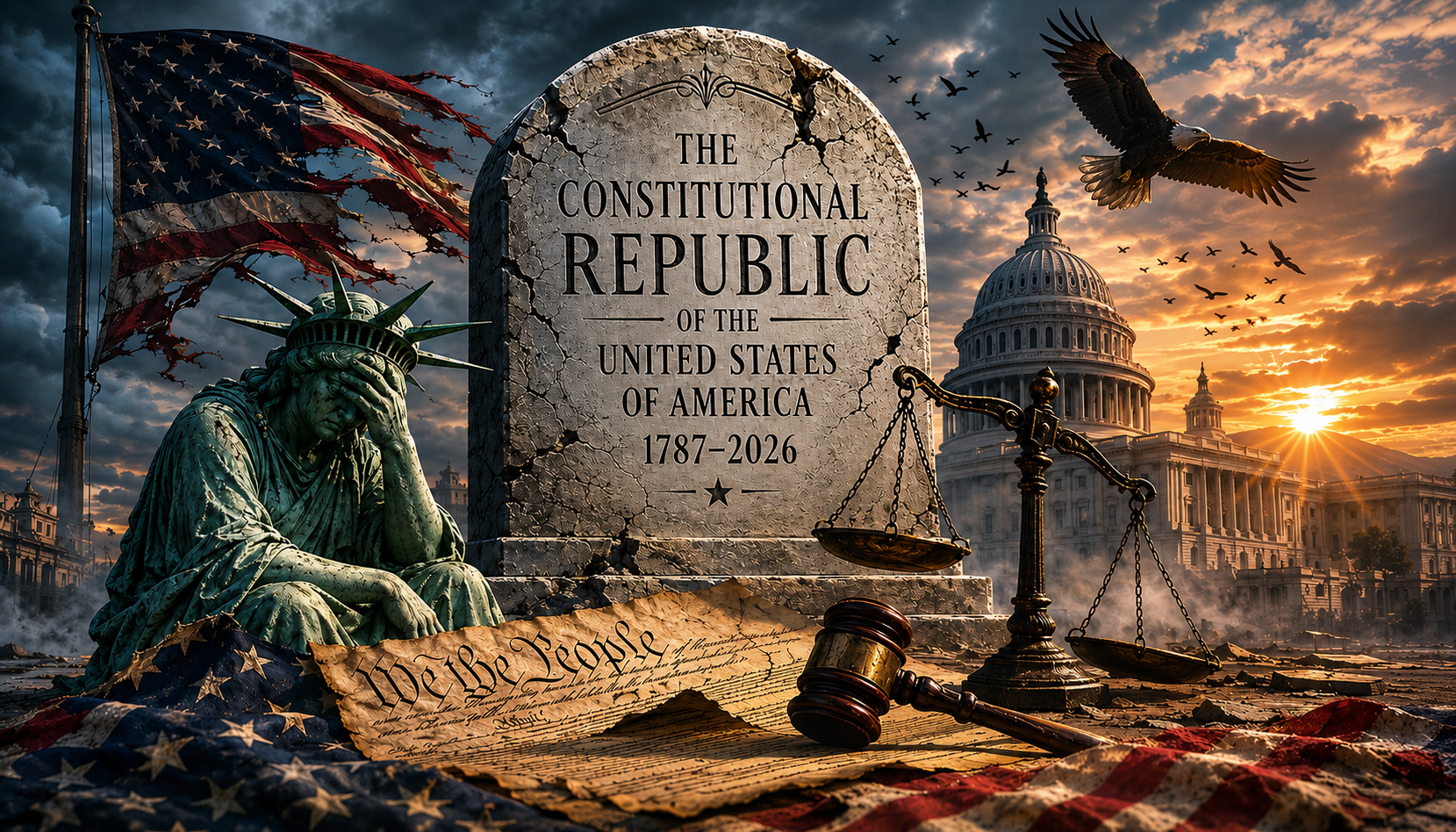
Born on September 17, 1787, in Independence Hall, Philadelphia, Pennsylvania, the Constitutional Republic of the United States drew its first breath from the Founding Fathers' deliberations. Conceived in the fires of revolution and tempered by fierce debate, it was a radical experiment. A government of laws was born, not of men seeking to impose their will by brute force. It had enumerated powers, leaving no room for unchecked authority. It comprised sovereign states and a federal union bound by the consent of the governed. Its birth certificate—the Constitution—proclaimed "We the People" as the source of legitimate power, establishing a system of separated branches, checks and balances, and a deliberate diffusion of authority designed to frustrate ambition and preserve liberty.
For much of its history, this Republic endured. It survived civil war, world wars, economic depressions, and profound social transformations. It achieved unparalleled prosperity, defended freedom abroad, and stood as a beacon against tyranny. Its genius lay not in perfection but in its self-correcting mechanisms: a Congress meant to deliberate and represent, an executive constrained by law, courts anchored in the Constitution as the supreme law of the land, and citizens expected to be vigilant.
Yet on May 19, 2026, the Republic died, and on this day we mourn its passing. The Republic died not with sudden violence or foreign conquest, but through a long, wasting illness: the gradual erosion of institutional integrity, the triumph of partisan loyalty over constitutional duty, and the rise of what scholars have called the "Imperial Presidency" and an unaccountable administrative state. Money flooded the political arteries. Executive power expanded relentlessly, often with congressional acquiescence. Legislators increasingly voted not by the Constitution or even by consistent principle, but by prevailing political winds, party leadership, or donor interests—precisely the dangers Thomas Massie warned against when he said:
“If legislators always vote with the President, we have a king. If legislators always vote with the prevailing wind, we have mob rule. If legislators always vote with the Constitution, we have a Republic.”
Massie’s recent primary defeat was a poignant final symptom of the Republic’s slow death, the nail in its coffin. A consistent voice for limited government and constitutional fidelity found himself sidelined in a political environment where such independence had become a liability rather than a virtue. His loss, amid celebrations by some who had once decried similar dynamics under previous administrations, revealed a deeper rot: the normalization of hypocrisy, the prioritization of short-term tribal victory over long-term republican health, and the reluctance of too many—across factions—to defend institutional norms when doing so became inconvenient.
The causes of death were many: the failure of Congress to reclaim its rightful powers; the growth of a permanent bureaucracy wielding quasi-legislative authority; the transformation of elections into expensive spectacles dominated by fundraising and the media; and a citizenry increasingly distracted, divided, and disillusioned, engaging in tribal-like antics and idolizing their favorite politicians above the rule of law set forth in the Constitution. What began as a Republic of reasoned debate and accountability morphed into something resembling managed democracy—where forms and rituals persist, but the substance of self-government fades.
The Republic is survived by its founding documents, which remain as aspirational as ever; through pockets of resistance in state governments, courts, and among citizens still committed to first principles; and by the eternal truth articulated by Benjamin Franklin: "A republic, if you can keep it."
Funeral services will be held in the hearts of those who still believe in limited government, individual liberty, and the rule of law. In lieu of flowers, we ask for renewed civic engagement, a rigorous defense of constitutional boundaries regardless of which party holds power, and the courage to speak truth to power—even when it wears familiar colors.
The experiment was noble. Whether it can be revived remains the urgent question for the living.
Born on September 17, 1787; died on May 19, 2026.
“Requiescat in pace.”

