
🔥 THE HIDDEN COST OF INTELLIGENCE SERVICE
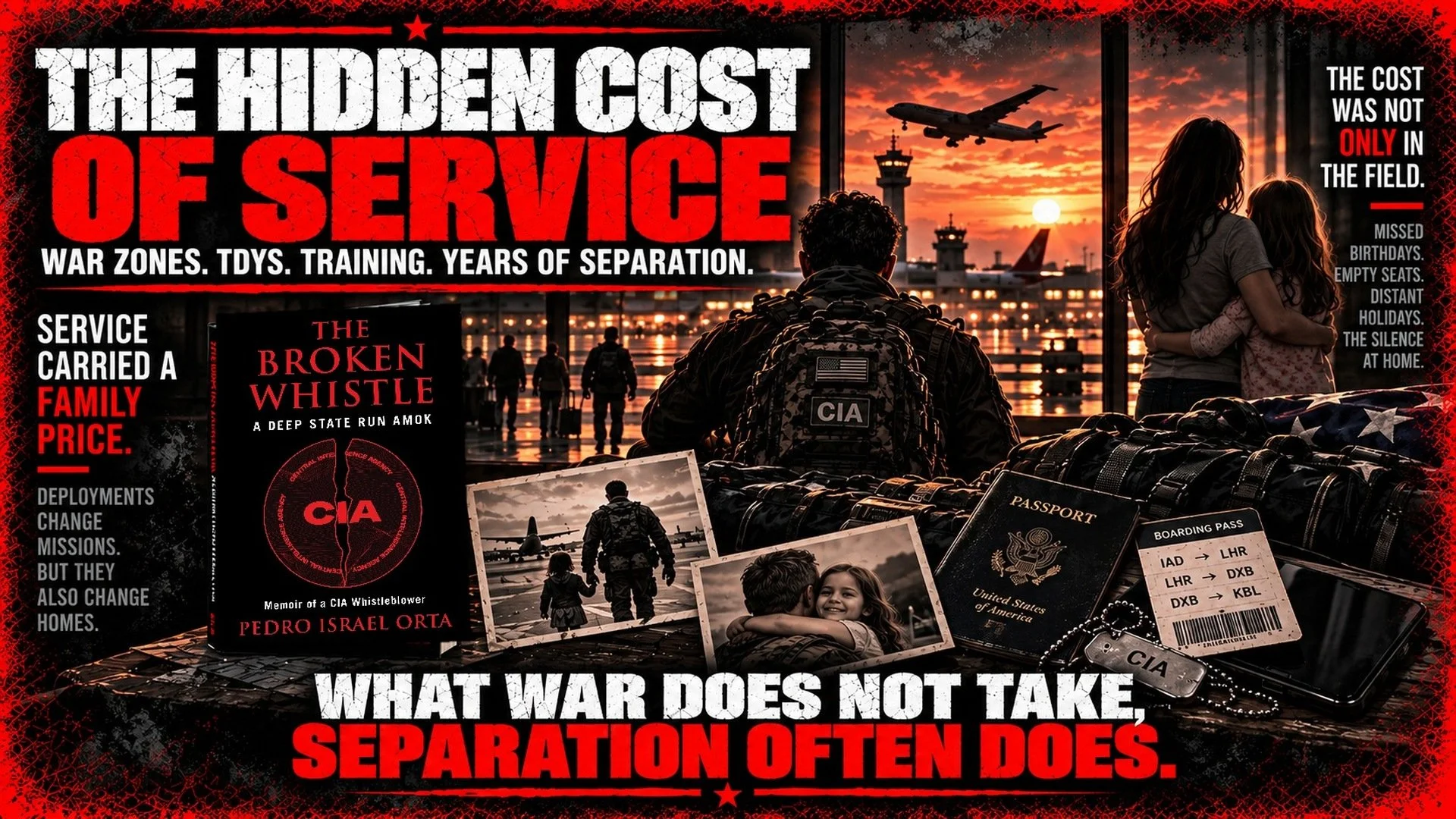
So you want to work for the CIA? Then look beyond the mystique and count the real cost: the family sacrifices, the missed milestones, the grief carried from a distance, and what happens if the very institution you served decides you are expendable.
When people talk about CIA service, they talk about operations, war zones, terrorism, intelligence, secrecy, and national security. What they almost never talk about is the bill that gets handed to the family.
They do not talk about the birthdays missed, holidays lost, funerals missed, marriages strained across continents, children growing up in fragments, aging parents left behind, or the physical and psychological wear that follows an officer home. The Broken Whistle tells that story too.
My CIA career included two years in Iraq, fifteen months in Afghanistan, seven months at a Middle East station, and a two-year foreign tour in a country at war. On paper, those years sound like service and sacrifice. In real life, they came with a cost. A VERY HEAVY COST.
THE FAMILY SERVED TOO

My daughter was born on December 14, 2009. I was with her for only 16 days after her birth before duty took me away again. Then came the pattern:
119 days apart before the first reunion
75 days apart before the next
77 days apart before the next
104 days apart before a reunion that lasted only 40 days
76 days apart before another reunion
57 days apart before another
76 days apart before another long separation cycle ended.
For years, our life was a cycle of short reunions surrounded by long absences. By my own reconstruction, during the early years of my daughter’s life, we spent only about 40 percent of the time together and roughly 60 percent apart. Let that sink in. A father serving his country, but absent for most of his daughter’s earliest years.
That is not a slogan.That is not symbolism. That is the human math of intelligence service. We missed her first, third , and fifth birthdays. Her second birthday came under the shadow of an orthopedic surgery with complications. We missed Christmas 2010, Christmas 2012, and Christmas 2014. We missed New Year’s 2009–2010, 2010–2011, 2012–2013, and 2014-2015.
In truth, Christmas 2013 was our first real Christmas together, and New Year’s 2013–2014 was our first real New Year’s together as a family. At one point, after all the turmoil and separation, our first real vacation together did not happen until twenty-three months after my daughter’s birth. That is the part of national-security service nobody puts on the résumé.
THE COST WAS NOT LIMITED TO MY WIFE AND DAUGHTER
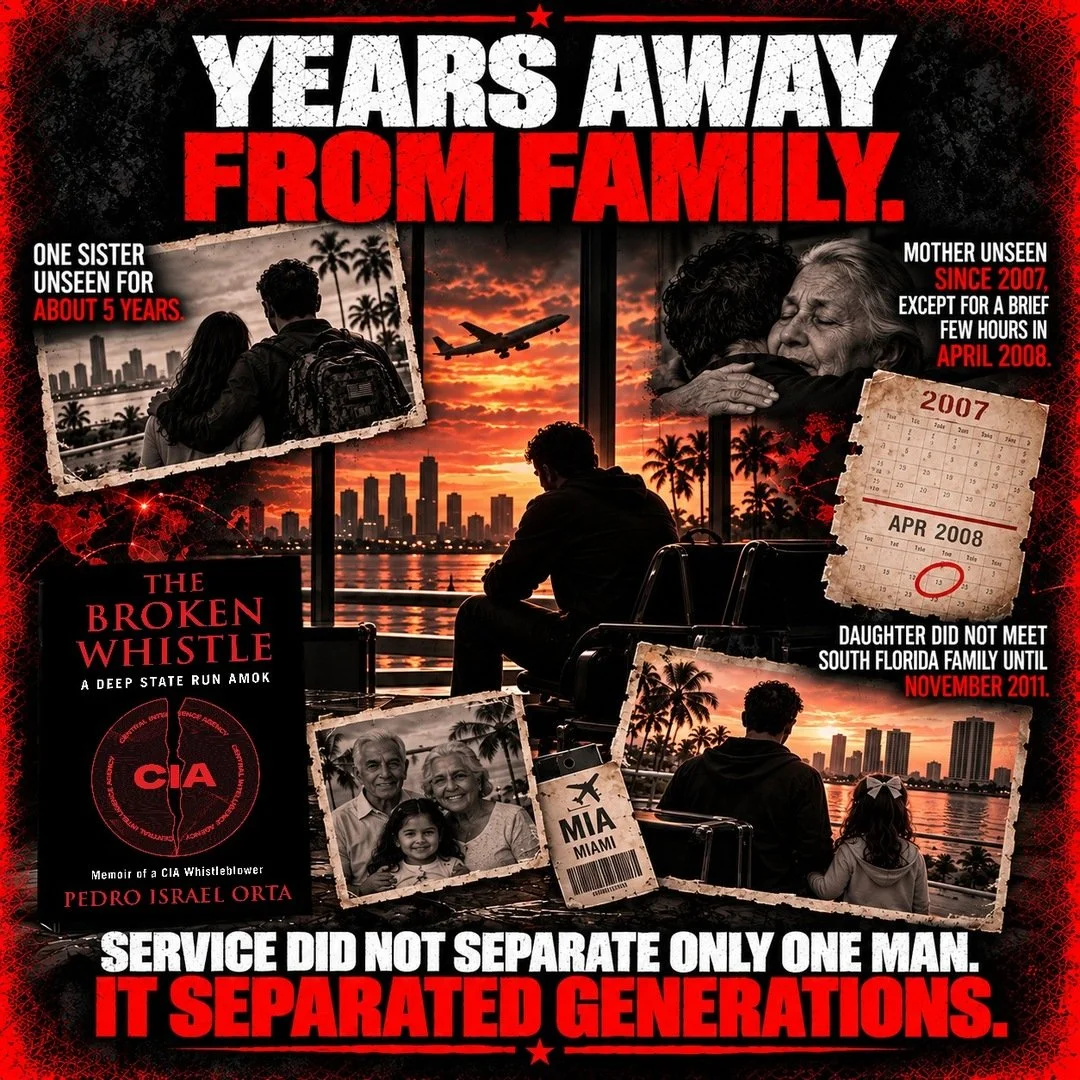
The separation from my mother, sisters, and family in Florida was also profound. My mother saw my daughter only three times in brief visits over many years. Seeing her for the first time at age 23 months old. A few times in 2014 and 2015, and then she had to wait until 2022 to see her again. This is no way to live, all caused by service and the consequences of reprisal.
The strain of trying to hold together a marriage, raise a daughter, maintain a home, navigate immigration complications, endure deployments, TDYs and PCS assignments, and then survive the nightmare of whistleblower reprisal, meant that my own family often bore the greatest cost.
That is another truth people do not often say plainly: Service in the CIA can mean losing irreplaceable years with the people waiting at home. Add the consequences of whistleblower reprisal, and the cost can extend far beyond a career to marriage, family, health, stability, and time that can never be recovered.
DUTY ALSO STOLE FINAL GOODBYES
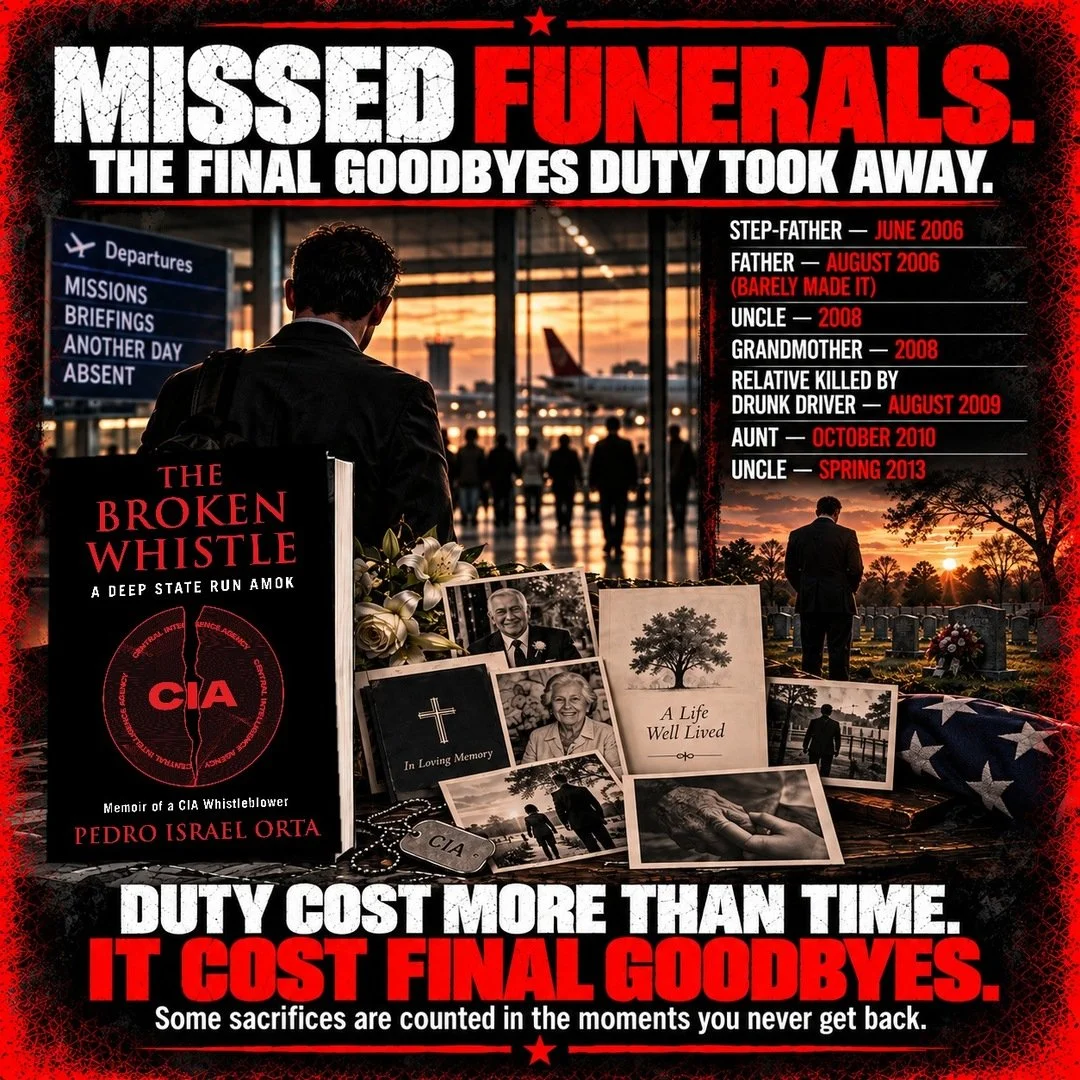
The cost included death and grief. I missed or nearly missed family funerals and losses, including:
My stepfather in June 2006
barely making it to my father’s funeral in August 2006
an uncle in 2008
my grandmother in 2008
a family death tied to a drunk-driver tragedy in August 2009
an aunt in October 2010
another uncle in the spring of 2013.
People talk about patriotic sacrifice in the abstract. This is what it looks like in real life: You serve the mission, and sometimes the mission takes your chance to say goodbye.
THE BODY KEEPS THE SCORE
The cost was physical too. Years of overseas service, war-zone pressure, stress, exhaustion, and the grind of constant movement eventually caught up with me. The medical consequences became serious enough to require surgery, while the accumulated fatigue and strain also affected family life.
There comes a point where a person realizes the mission did not just take time. It took health too. And the war zone does not always stay in the war zone. One moment captures the psychological impact.
While staying at a hotel overseas, loud explosions jolted me awake. After years of hearing rockets, mortars, small-arms fire, and battlefield explosions, I instinctively rolled out of bed, took cover, and began assessing what I thought was an attack.
It turned out to be fireworks from a nearby concert. That may sound almost ironic in retrospect. But the truth underneath it is not ironic at all: Repeated exposure to dangerous environments changes the nervous system, changes perception, and changes how a person lives in the world.
THIS IS THE PART PEOPLE FORGET
We talk about missions, operations, patriotism, and sacrifice. But too often we forget who pays. The officer serves. The spouse serves. The child serves. The family serves. And long after the deployment, the TDY, the PCS, the war zone, and the briefing are over, the cost can still be sitting in the home, in the body, in the memories, and in the relationships.
That is why this material matters. Because alongside the Baghdad lessons, the Potemkin lessons, the Chapter 7 leadership study, the Afghanistan history, and the oversight failures, there is another case study that must be told plainly:
THE HUMAN COST OF SERVICE: FAMILY, HEALTH, LOSS, AND THE PSYCHOLOGICAL IMPACT OF PROLONGED INTELLIGENCE OPERATIONS
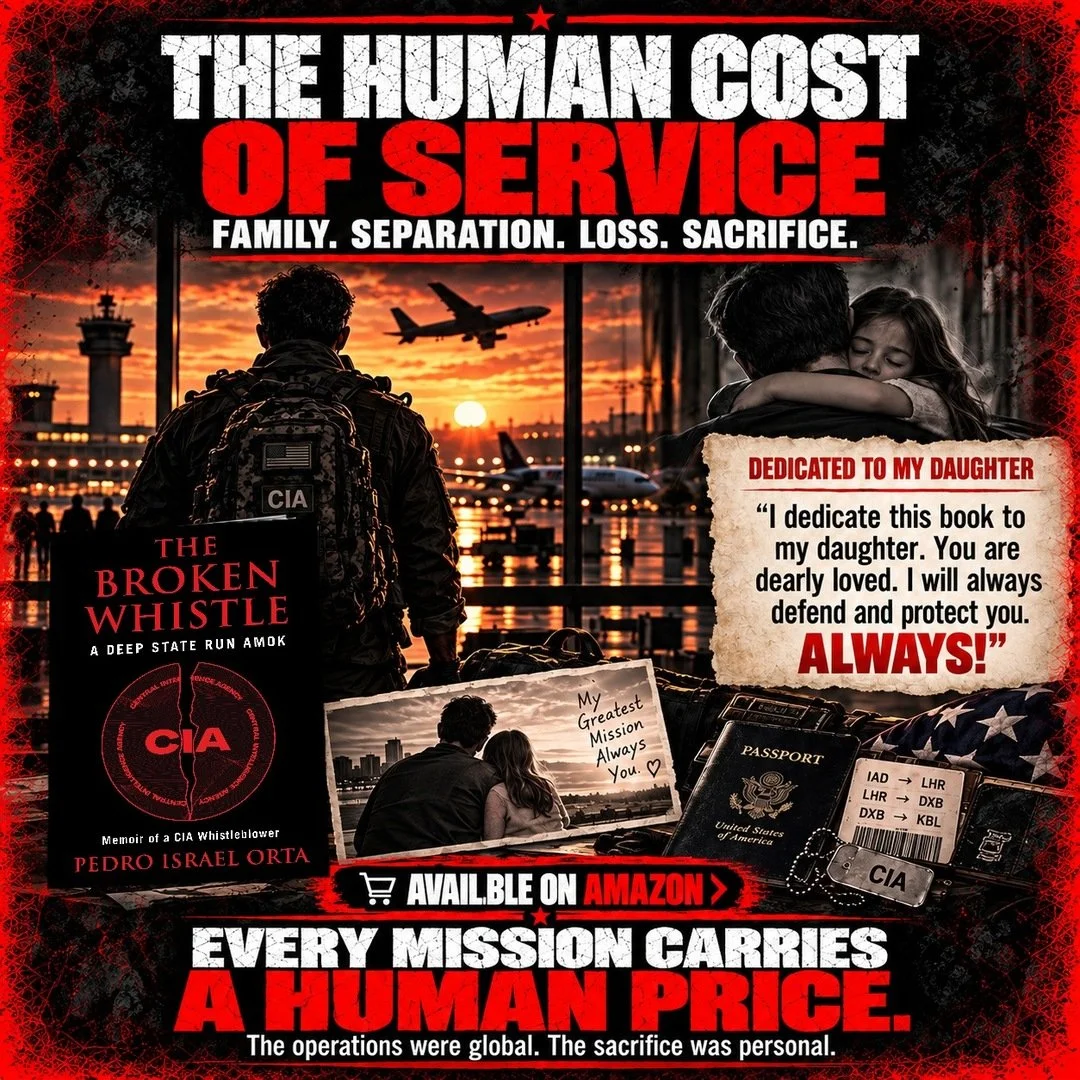
The mission took more than time. It took pieces of a life.
Where are the voices that preach pro-life, pro-God, and good government when the cost of government service becomes this personal?
If The Broken Whistle is exposing failures they claim to oppose, who is actually standing up, asking questions, and demanding accountability? And who is simply staying silent? Or what help are they lending, if any? Or is it all noise for clicks, fame, glory, and personal profit?

