
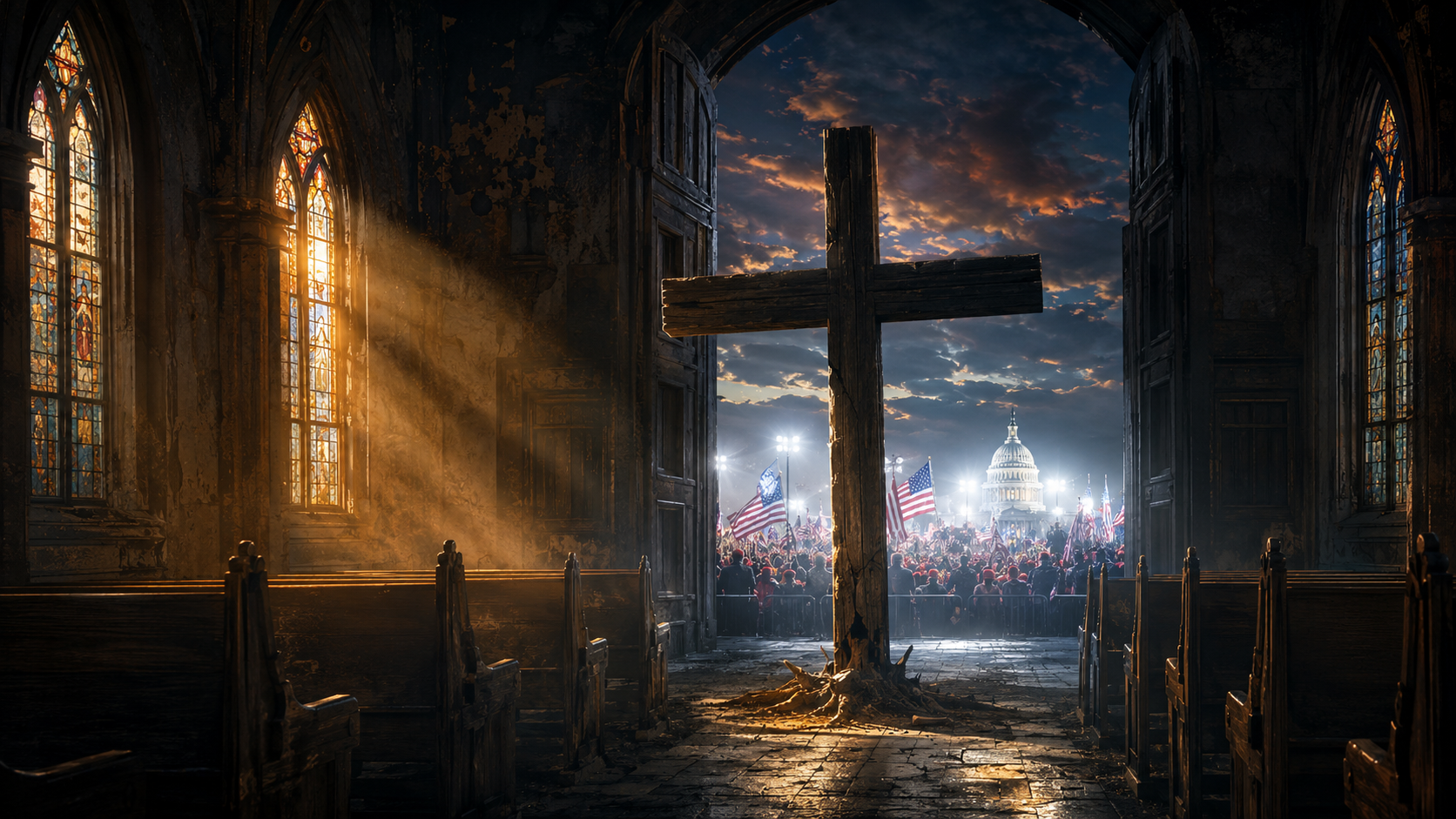
Donald Trump’s 2024 electoral victory did not occur in a vacuum. Roughly 80 percent of white evangelicals helped power sweeping Republican gains. Project 2025 is now reshaping federal agencies—expanding school vouchers, embedding biblical principles in education policy, and erecting safeguards against what many view as radical secular overreach.
Yet something deeper is rotting. Church attendance has declined for decades with little to no improvement except in rare instances. The religiously unaffiliated “nones” now comprise about 28 percent of the population. White evangelicals have declined to roughly 14 percent. As one voice observed: “America didn’t lose its way at the polls. It lost its way when it turned from God and crowned politics as ultimate.”
This painful paradox has defined four decades of evangelical political muscle: repeated electoral victories and significant policy wins, even as the nation slides spiritually into deeper darkness. What began as a defensive response to Roe v. Wade in the 1970s evolved into a formidable alliance with the Republican Party. Organizations such as the Moral Majority, the Christian Coalition, the American Center for Law and Justice (ACLJ), and FlashPoint mobilized millions, flipped elections, and reshaped the judiciary. The question that must now be faced is blunt: Did the Kingdom of God truly advance, or is the nation slipping further into spiritual darkness?
Roots in Revival and Retreat
Evangelical engagement with politics is woven into the fabric of American history. The Second Great Awakening fueled successive waves of reform. The National Reform Association pressed for a constitutional amendment declaring the United States a Christian nation. Temperance advocates treated the prohibition of alcohol as a moral imperative.
The 1925 Scopes Trial left fundamentalists bruised and drove many into cultural retreat. Cold War pressures later restored public religious symbols such as “under God” in the Pledge of Allegiance. But Roe v. Wade in 1973 lit the fuse. Catholics sounded the alarm first; evangelicals soon followed, insisting that abortion was the taking of innocent life. IRS pressure on Christian schools was widely interpreted as an assault on religious freedom. Paul Weyrich, a shrewd Catholic strategist, helped bridge the Catholic-evangelical divide and forge the Moral Majority in order to defeat Jimmy Carter—the born-again Baptist who proved too liberal for many. White evangelicals shifted decisively, moving from roughly 50 percent Republican support in 1976 to a reliable voting bloc.
1980s: The Moral Majority’s Hammer
Jerry Falwell Sr. launched the Moral Majority in 1979 from Lynchburg, Virginia. The organization rapidly grew to four million members. Through television sermons, direct-mail campaigns, and large rallies, it targeted abortion, the Equal Rights Amendment, and homosexuality. In 1980 it registered two million new voters. Evangelicals largely backed Ronald Reagan, contributing to his 489–49 Electoral College victory.
Reagan rewarded the movement with appointments and supportive rhetoric. By 1984, approximately 80 percent evangelical support helped secure another landslide. Critics decried the movement’s intolerance. Financial difficulties contributed to the group’s dissolution in 1989, yet its activist spirit merged into the broader Republican coalition and continued to mobilize millions of born-again Christian voters.
1990s: The Christian Coalition’s Ground Game
After Pat Robertson’s unsuccessful 1988 presidential bid, the Christian Coalition emerged under Ralph Reed. It built nearly two million members and distributed some thirty million voter guides through churches. Its agenda remained focused: abortion, opposition to gay rights, and school choice.
The organization proved instrumental in the 1994 Republican Revolution, which netted 54 House seats and eight Senate seats. The Contract with America reinforced pro-life commitments, while state-level activism intensified. George H.W. Bush and Bob Dole benefited from this momentum, though their defeats also revealed the movement’s limits. IRS investigations and internal scandals weakened the organization. Today it functions primarily as a lobbying presence centered in South Carolina. Grassroots power remains real, but sustained dominance has proven elusive.
Legal Warriors: The ACLJ in the Trenches
Jay Sekulow’s American Center for Law and Justice (ACLJ), founded in 1990, became a formidable legal force. Sekulow, a Jewish convert to Christianity, built a global operation closely tied to Regent University. The ACLJ secured numerous Supreme Court victories involving equal access for religious groups in schools and protections for pro-life protesters.
It engaged cultural battles both domestically and internationally, later defended Trump allies, and contributed to Project 2025. Substantial funding enabled decades of precedent-setting litigation, and its advocacy continues.
2000s–2010s: Expanding the Front
Focus on the Family and the Family Research Council broadened the movement’s scope, opposing same-sex marriage and embryonic stem-cell research while advocating for homeschooling. George W. Bush received 78 percent evangelical support and signed the Partial-Birth Abortion Ban while expanding faith-based initiatives.
The 2015 Obergefell decision legalizing same-sex marriage marked a major setback. Evangelical turnout rose as high as 70 percent in some cycles, yet cultural shifts continued largely unabated.
2020s: Trump, Dominion, and Prophetic Fire
Donald Trump reshaped the political landscape and was widely viewed by many evangelicals as a flawed vessel in a larger spiritual war. He secured roughly 81 percent of the evangelical vote in both 2016 and 2020. His three Supreme Court appointments paved the way for Dobbs v. Jackson Women’s Health Organization in 2022, which triggered abortion restrictions or bans in numerous states.
Lance Wallnau’s Seven Mountain Mandate and the FlashPoint Army—led by Gene Bailey and prophets such as Hank Kunneman—framed electoral politics as spiritual warfare. Rallies, livestreams, and Project 2025 efforts drew tens of thousands. By 2026, several red states have begun integrating Scripture into public-school curricula, while voucher programs continue to erode centralized federal control over education.
The Scorecard
Evangelical support for Republican candidates rose from roughly 50 percent before 1980 to more than 80 percent in recent cycles. Turnout increased. Tangible victories include Dobbs, strengthened protections for school prayer and religious liberty, and billions in faith-based grants. Early implementation of Project 2025 is consolidating many of these gains.
The Bitter Harvest
Political success, however, masks a harsher reality. Self-identified Christians have declined from about 85 percent of the population in the 1980s to roughly 62 percent today. Weekly church attendance has fallen sharply—from around 40 percent or higher in earlier decades to the low teens in recent surveys. White evangelicals now constitute approximately 14 percent of the adult population. Divorce rates among evangelicals remain high. Broader cultural acceptance of LGBTQ identities has climbed toward 70 percent, even as support among Gen Z evangelicals remains far lower.
Many biblical interpreters read these trends as a form of judgment—God giving a people over to their own desires (Romans 1). Politicized faith has alienated some younger believers who perceive hypocrisy and a misplaced ultimate hope. Voices such as Tim Keller warned that an overly political posture risks becoming culturally obsolete. Symptoms were treated with legislation while hearts were neglected. Churches pursued influence and therapeutic self-help; pews emptied even as bold prophecies continued to sound.
Reckoning and Renewal
Evangelical political activism has undeniably reshaped American politics—helping elect conservative leaders, overturning Roe, and constructing policy defenses for religious liberty. It has demonstrated formidable electoral power. Yet the nation’s spiritual condition remains fractured. Political victories prove fragile without repentance.
True renewal requires more than ballots. Historically, hardship has often preceded revival. Some post-Dobbs stirrings are already visible. The decisive test remains: Will culture be conquered primarily through raw political power, or will there be a return to the cross marked by humility and transformed hearts?
As 2026 unfolds, the necessary focus must shift toward repentance and spiritual renewal. Political activism alone will neither save America nor usher in a Great Awakening. Only the preaching of the Gospel of Jesus Christ can do that.

